
This user has no description yet

lalana
That neat slit in the curtain is the killer's only signature.🧐
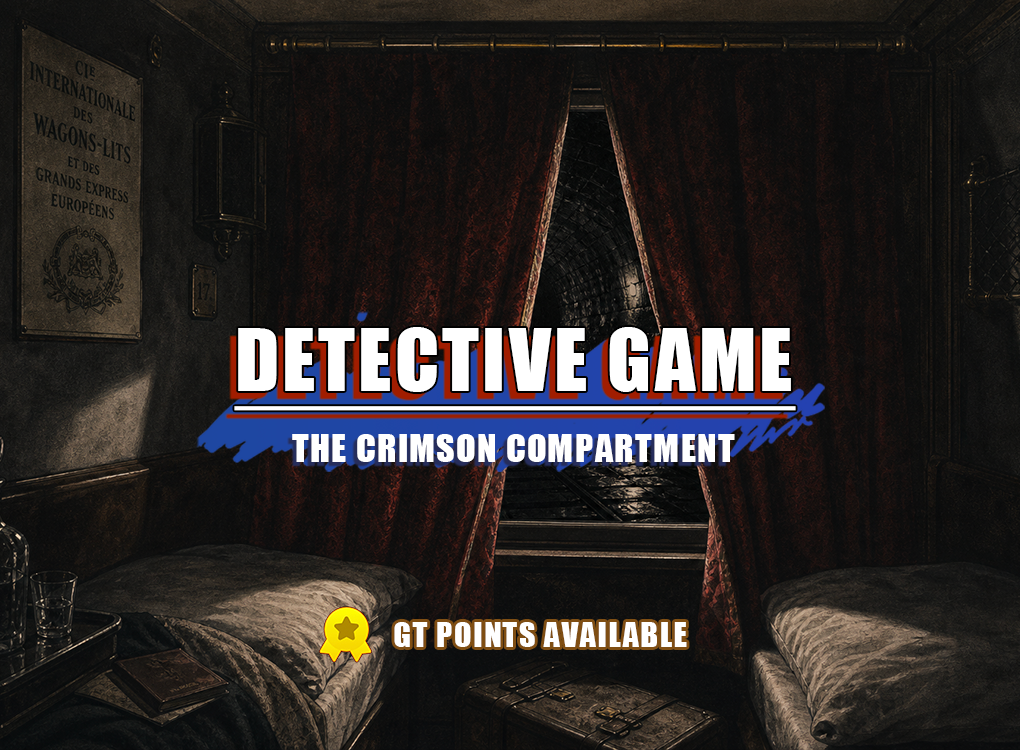
📕Story Background
The year is 1920s, the golden age of British railways, deep autumn.
The Auroral is a luxury overnight express from London to York, famous for its privacy, comfort, and high‑society passengers. It includes an exclusive private sleeper carriage with only four compartments: A‑1, B‑2, C‑3, D‑4, each fitted with its own lock and an internal bolt.
The victim, Mr. Alistair Finch, is a reclusive, fabulously wealthy art collector. Five years ago, he purchased a painting at auction – a long‑lost Renaissance work titled The White Rose Lady – whose authenticity has been hotly disputed. Finch once co‑ran an art gallery with Mrs. Genevieve Shaw, but they became enemies over the ownership of that painting. Also on board is Professor Aris Thorne, a disgraced historian who once tried to sell Finch a forged classical drawing; Finch exposed him publicly, ruining his career. The young waiter Pavel Krol is Finch’s personal attendant for the journey, responsible for serving meals, drinks, and locking the compartment.
On the night of the murder, Finch boards The Auroral in London, heading for his country estate near York. He orders that no one disturb him after 11:20 PM. The train enters the Meridian Tunnel at 11:23 PM – four minutes of absolute darkness. After the train emerges, the conductor knocks to remind passengers of the next stop, but Finch does not respond. At 11:45 PM, the conductor forces the door open and finds Finch dead.
🔍Known Clues
The following evidence was found by investigators in the private sleeper car "The Auroral" on the 11:45 PM express train to York, shortly after it passed through Meridian Tunnel.
1.The Scene: Mr. Alistair Finch is found dead inside his locked, private compartment (D-4). The door was bolted from the inside. A conductor broke the latch to enter after Finch failed to respond to three scheduled stops.
2.The Body: Finch is slumped over a small, fold-down table. A single, precise puncture wound is visible on his left temple. No weapon is found in the room. A half-empty glass of bourbon sits by his hand.
3.The Window & Curtain: The heavy curtain over the window is drawn shut. A single, vertical slit (about 3 inches long) has been cut into the fabric. The window glass beneath it is intact and still locked from inside. On the outside surface of the window glass, faint traces of gunpowder residue and a circular grease mark (exactly the diameter of a pistol muzzle) are found.
4.The Floor: Near the door, a small, crushed cluster of dried white rose petals. Under the table, a single, unused monocle (no chain, just the lens loop) rests on the carpet. A tiny fragment of blackened cork is stuck to its inner rim. Mr. Finch did not wear a monocle, according to staff.
5.The Passenger List: Only three other people had tickets for the private sleeper cars:
- Mrs. Genevieve Shaw (C-3) – estranged business partner.
- Prof. Aris Thorne (A-1) – disgraced historian.
- Pavel Krol – young waiter employed by the railway.
6.The Timing: Train entered Meridian Tunnel at 11:23 PM, exited at 11:27 PM. Conductor confirms the compartment was locked and quiet before the tunnel. Body discovered at 11:45 PM.
7.Personal Effects Search:
8.In Prof. Thorne’s luggage: a small, high‑pressure air pistol (disguised as a vintage cigarette lighter) and a pair of antique opera glasses with one missing lens. The missing lens matches the monocle found in Finch’s room.
9.In Mrs. Shaw’s compartment: a broken perfume bottle with white rose petals floating in the spill – but the petals are fresh, not dried.
10.Pavel Krol has a conductor’s timetable in his pocket, but his hands show no gunpowder residue or grease (tested immediately after discovery).
🕵️Questions and Discussions for YOU
- Who killed Alistair Finch, and how was the locked‑room murder achieved?
- Have you ever visited a science museum, polar exhibition, or similar event? Share an interesting experience.(Open-ended)
🎉Participation Rewards
The FIRST user to successfully deduce the identity of the "culprit" and their motive in the comment, will receive a reward of 2,000 GT points! Other participants will earn 200-500 GT points based on the completeness of their submissions. 💰(Except for extended special edition)
📅Submission Deadline
May 22, 2026
Reminder: This is the submission deadline if you want to claim the reward with your vote, but after this date the vote will still remain open for a period of time, so please feel free to participate at any time if you want to test your skills, detectives!
----- Previous answer (Gone the Aurora Opal) -------
Culprit: Dr. Frost
Motive: Dr. Frost resented that the Aurora Opal, a scientifically significant mineral specimen, was being treated as a social showpiece for a charity auction rather than a research sample. He planned to steal it and hide it in his personal specimen box, later taking it back to his home lab.
Deduction Logic:
- The thermal camera cannot see through glass.
- Dr. Frost claimed he saw the opal's "thermal signature" inside the glass display case. But consumer thermal imagers use long-wave infrared, which cannot penetrate ordinary glass. The glass reflects or absorbs infrared radiation, so the imager would only show the temperature of the glass surface (roughly room temperature), not the opal behind it.
- This is basic knowledge that any real glaciologist or frequent thermal imager user would know. Dr. Frost invented a "scientific detail" to sound credible, but it exposed his lack of genuine expertise.
- Why the others are not guilty (or their lies are not about the theft):
- Kai: His gloves had moisture but no frostbite — this actually proves he used proper protective equipment, suggesting professionalism, not guilt. The Dewar flask discrepancy could be measurement error. He had no direct opportunity to grab the opal with his back turned for only 30 seconds while the theft required reaching into the case.
- Colonel Rivas: He claimed to see "a hand with a red cuff" reflected in the metal pillar. But the pillar has a matte brushed finish — it cannot produce a clear enough reflection to distinguish cuff color, especially through dry ice fog. Rivas is lying, but his lie is likely to make himself seem observant (or to cover up that he was dozing off), not to cover a theft. However, if he were the thief, he would invent a simpler alibi rather than a detailed false observation.
- Poppy: She claimed her fan cleared the fog. Tests proved her small fan cannot effectively move the dense dry ice fog inside the case. But she might have genuinely believed it worked — this is an overestimation, not a scientific impossibility.
- The decisive factor: Dr. Frost's statement contains a physically impossible claim (thermal imaging through glass). The others' statements contain exaggerations or optical misunderstandings, but not fundamental violations of physics. Moreover, Dr. Frost had the best opportunity: as a scientist "observing" near the case, no one would question his presence. He could have used a long thin tool to reach through the top vent, grab the opal, and conceal it in his specimen case.
Crime reconstruction:
During the light flicker (possibly caused by Dr. Frost tampering with a plug), Dr. Frost inserted a fine grasping tool through the top vent of the display case, snatched the opal, and dropped it into his insulated sample box. The billowing dry ice fog hid his hand movement. He then invented the thermal imager story to establish a timeline and portray himself as a focused scientist who had no chance to steal.
We will be rewarding 200 GT points to all players who voted correctly, and additional points to some outstanding responses.
Congratulations and enjoy your juicy GT points reward!!!
Translate

Popular Posts
1
The Eclipse Observatory
171 discussions 236 views
2
![[Vote]The Alpine Ascent- Detective Game](https://oss.gtarcade.com/forum/jpg/2026-07-16/1325191_e39319f4-9f18-4b51-8995-347153e2264f_144402.jpg?x-oss-process=image/resize,w_150,h_150)
[Vote]The Alpine Ascent- Detective Game
1.2K discussions 2.9K views
3
![[Vote]The Museum Murder- Detective Game](https://oss.gtarcade.com/forum/png/2026-07-10/1325191_2f99bcda-0dc5-4f61-ab5b-b485b559663f_130811.png?x-oss-process=image/resize,w_150,h_150)
[Vote]The Museum Murder- Detective Game
1.5K discussions 3.6K views