
This user has no description yet

realsarduka
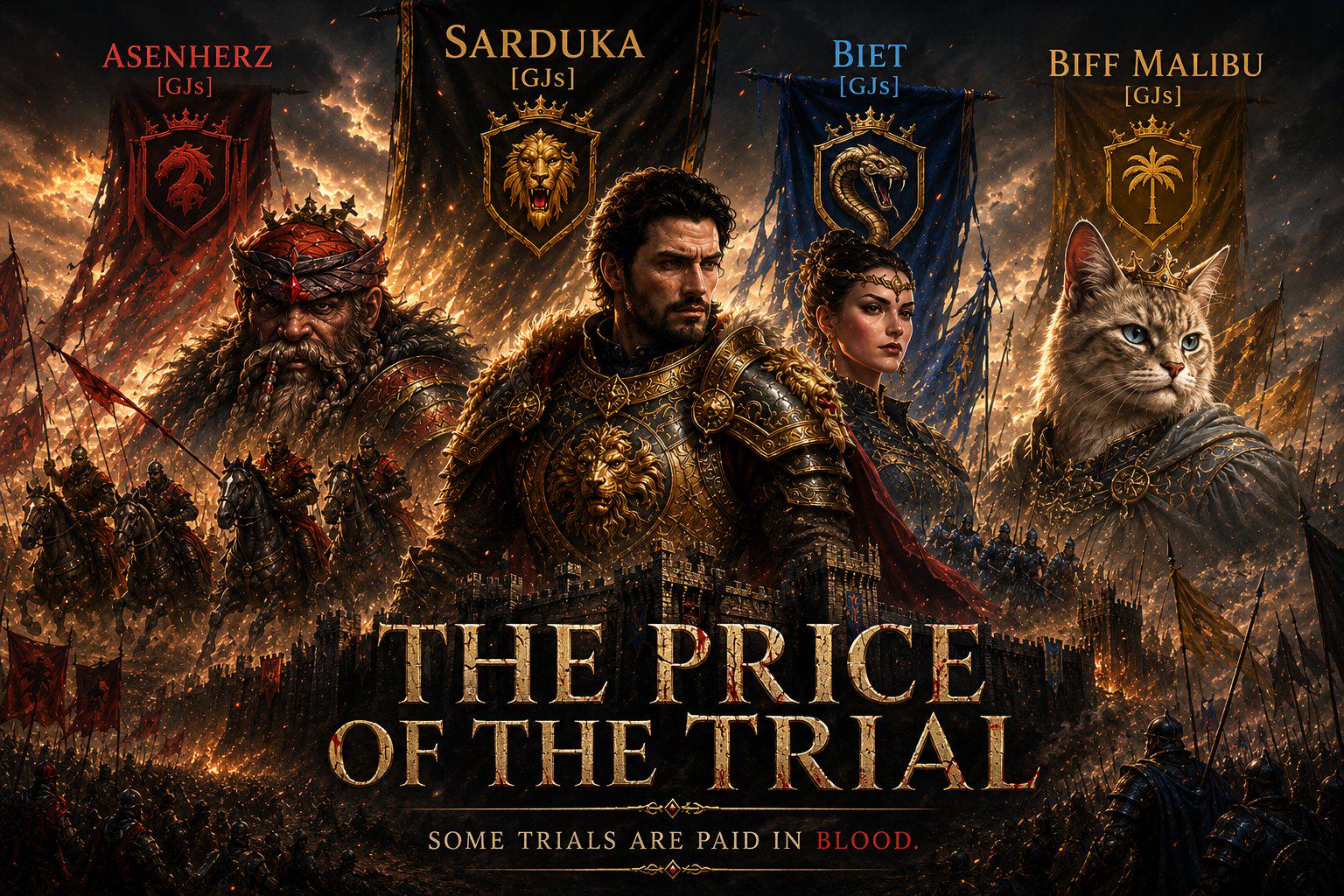
The Price of the Trial
As I stepped onto the walls of my fortress that morning, an almost unreal calm lay across the land. Mist still lingered over the fields, making the world seem smaller than it truly was, while the first rays of the rising sun bathed the towers and battlements in pale gold. Deep below me, the garrison was coming to life. Blacksmiths stoked their fires, officers reviewed their final reports, and thousands of soldiers prepared themselves for a day whose outcome none of them could foresee. Officially, it was meant to be nothing more than a trial. Asenherz wished to test the strength of his attack formation under real battlefield conditions, while Biet had decided to give his new Commander Euron, his very first true test of leadership. This was not about territory, power, or the conquest of a fortress. It was about answers. Yet answers found on a battlefield have an unfortunate habit of never coming free of charge.
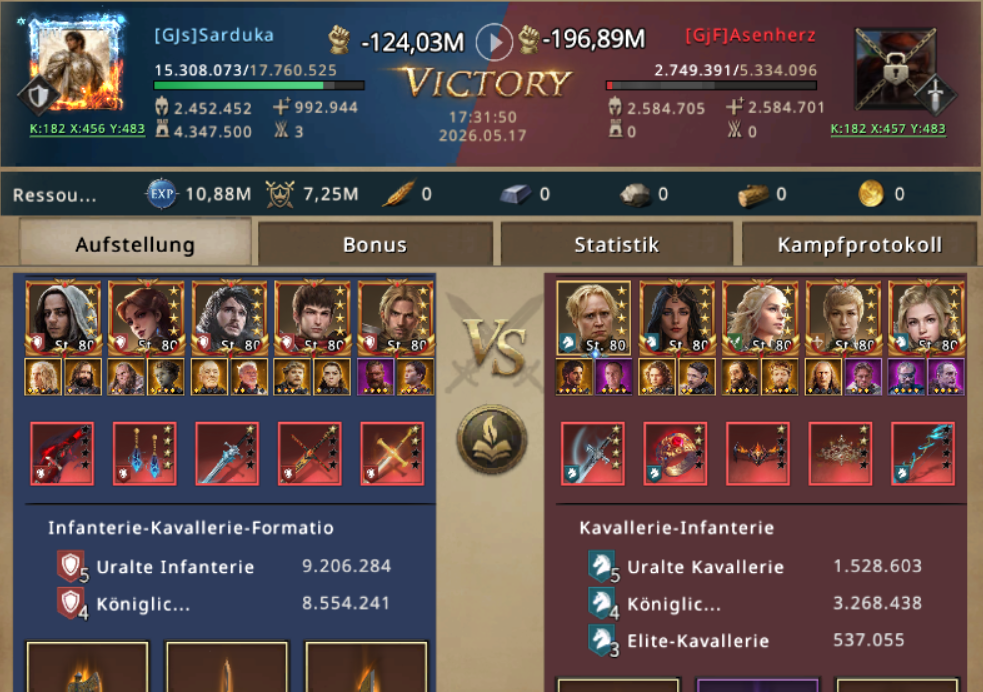
Behind my walls stood 17,760,525 soldiers ready for battle. 9,206,284 Tier 5 veterans formed the backbone of my defense, supported by another 8,554,241 Tier 4 warriors. It was an army that had been built over many months, one whose sheer size commanded respect even from the most experienced commanders. As I looked across the ranks, I was not thinking about numbers. I was thinking about men. Men who had trained beside their brothers in arms, men who trusted their commanders to make the right decisions, and men who did not yet know that this might be the last day of their lives. In the distance, the first banners finally emerged from the mist, and with them, the peace of that morning came to an end.
Asenherz had chosen a cavalry formation, and even from afar I could tell how much effort had gone into its design. The riders did not move like separate units but like the limbs of a single living creature crawling across the plain and growing larger with every passing minute. The thunder of hooves could be heard long before the first ranks entered the range of our defenses, and even atop the walls the vibration of the ground could be felt beneath my feet. The moment the attack began, any illusion that this was merely a test vanished. The cavalry struck our lines with a force that impressed even seasoned veterans. Shields splintered, swords shattered, and men were trampled beneath iron shod hooves as the attacking formation repeatedly applied pressure and searched for weaknesses in our defense.
More than once I found myself admiring the precision with which Asenherz commanded his forces. Every advance seemed carefully calculated, every movement carried a purpose. At the same time, I watched my own soldiers fight as though their lives depended on it, because they did. Whenever a line threatened to collapse, reserves moved forward. Whenever a gap appeared, it was sealed. Hour after hour the battle raged before the walls of my fortress until the dust finally settled and the first reports arrived. Only then did the true cost of the first trial become clear. More than 2.4 million of my soldiers had fallen. Nearly another million lay wounded in the infirmaries. Though the defense had held, I knew in that moment that this was only the beginning.
The men upon the walls did not cheer. No one celebrated. Everyone understood that the plain before us had been soaked with the blood of those who had stood among us only hours earlier, and that the next trial was already on its way.
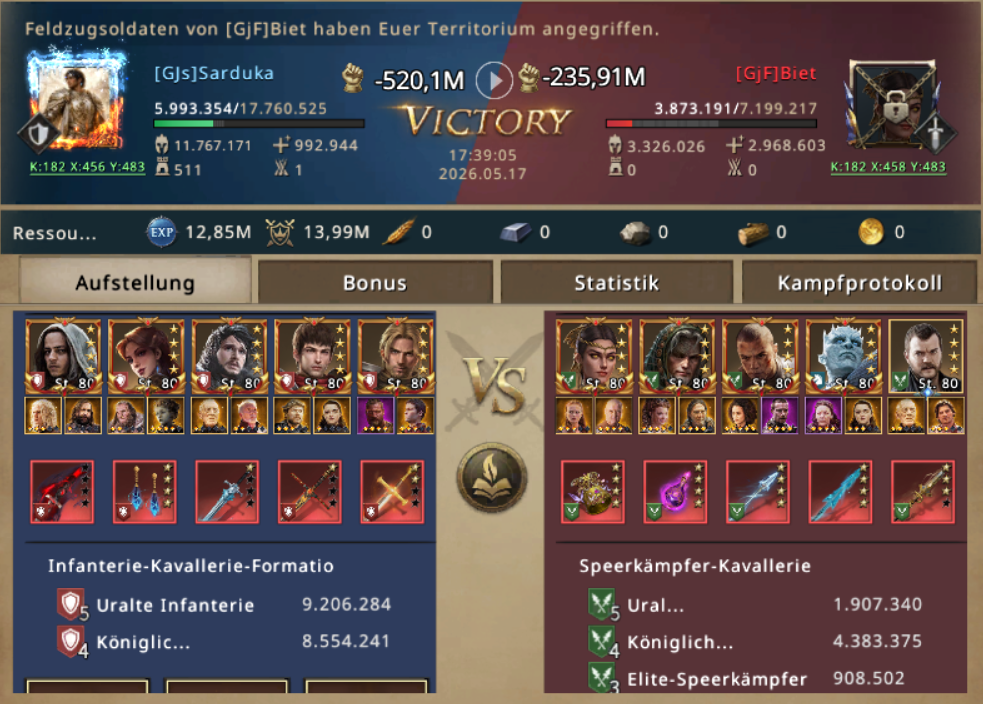
No sooner had the healers begun their work and the officers started assessing the losses than Biet's banners appeared on the horizon. The first battle had weakened our garrison, yet there was no time to tend to our wounds or reorganize the ranks. Somewhere behind those banners stood Euron, the commander to whom Biet had entrusted real responsibility for the very first time. I knew his name, but on that day he was less a man than a question to which Biet sought an answer. Had his trust been justified or not?
The formation approaching my fortress felt different from Asenherz's. Calmer. More methodical. Almost as though it already knew every step before it was taken. As the attack began, it quickly became clear that the first battle had left its mark. The men upon the walls fought with the same determination as before, yet their ranks were thinner now and their reserves smaller. Every mistake carried a heavier price than it had only a few hours earlier. The battle developed a ferocity that surprised even me. Time and again I believed the defense was stabilizing, only to watch fresh assaults crash against our lines moments later. The hours passed, and with them the strength of my garrison slowly faded away.
When the final reports were eventually placed upon my table, I stared at the numbers for a long time without speaking a single word. Of the original 17,760,525 soldiers, only 5,993,354 remained fit for battle. More than 11.7 million men had lost their lives. Nearly another million lay wounded in the hospitals. Even for someone who had witnessed countless battles, it was a number that was difficult to comprehend. For the first time that day, there was no tension left upon the walls. Only silence. A heavy, oppressive silence that settled over the entire fortress like a dark cloak. A victory that did not feel like a victory.
For a long time I studied the reports, as though the numbers might change if I stared at the parchment long enough. Yet they remained exactly the same. More than eleven million men had fallen. Men who had stood upon these very walls that morning. Men who had sharpened their weapons, greeted their comrades, and believed they would live to see the evening. Numbers are a strange thing. On a report they seem almost harmless. Mere strokes of ink upon a piece of parchment. Yet behind every single number was a face, a voice, a story that had now fallen silent forever.
In that moment, I understood that the greatest burden of a commander was not issuing orders or winning battles. It was learning to live with the decisions that cost others their lives.
Long after the final horns had fallen silent and even the hurried footsteps of the healers had become less frequent, I wandered alone through the fortress. The courtyards that had been filled with voices that morning now felt almost unfamiliar. Everywhere I looked, I saw the marks of what this day had demanded. Wounded men lay upon stretchers or sat silently against the walls while exhausted healers moved tirelessly from one patient to the next. Some places stood empty, though they should not have been. Earlier that morning, someone had stood there. Someone had laughed there. Someone had spoken of plans for the future. Now, only emptiness remained. The longer I walked through the fortress, the more I realized that while the walls had held, the men behind them had paid a price no report or statistic could ever truly capture.
Several officers sought me out and carefully voiced what many were already thinking. We had done our part. The trials were over. No one would have blamed us for keeping the gates closed and preserving what remained of our strength. Perhaps that would have been the most sensible decision. Yet as I walked among the survivors and looked into their faces, I came to understand that reason is not always the right path. These men had not endured two devastating assaults only to end the day in retreat. They had bled. They had suffered. And they had endured. If this day was meant to provide answers, then I would give my own answer as well.
As the sun slowly drifted toward the horizon, I ordered the gates opened. The deep groan of the massive timbers echoed through the courtyards, and heads turned throughout the fortress. Some looked surprised. Others looked uncertain. Yet not a single voice objected. Moments later, the survivors gathered before the gates. Wounded, exhausted, and only a fraction of the force that had stood behind these walls that morning, they were nevertheless ready to fight once more.
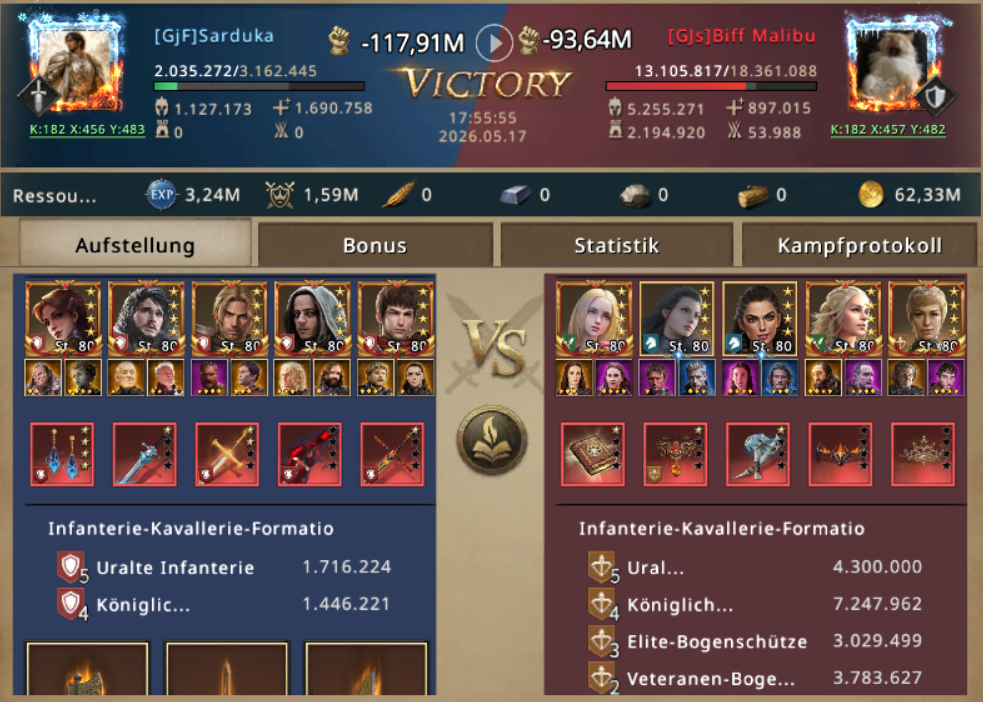
The campaign against Biff Malibu began that very evening, and many would likely have considered it a foolish decision. Our army was little more than a shadow of the force that had stood proudly behind the walls at dawn, yet during the march I noticed something that impressed me deeply. No one complained. No one questioned the order. The men marched silently through the fading light, and every one of them knew exactly why he was there. When we finally met the forces of Biff Malibu, it became clear almost immediately that numbers alone do not decide the outcome of a battle. His army was strong and his banners stretched across the plain before us, yet my soldiers fought with a determination possessed only by those who have already lost everything and still choose to move forward.
What had begun as another trial became a powerful reminder that morale and experience are sometimes worth more than any numerical advantage. Step by step we gained ground, forcing the enemy backward until they were driven onto the defensive. When the battle finally came to an end, the relief on the faces of my men was unmistakable. Not because they had defeated an enemy, but because they had proven something to themselves. They could still fight. They could still win.
Yet the true victory was not that we had defeated Biff Malibu. The true victory was that the men had begun to believe in themselves again. After the losses suffered at the walls, a shadow had settled over many faces, one that even our success against Asenherz had failed to lift. Now that shadow was gone. For the first time that day, I did not feel as though something had been taken from us. For the first time, we had reclaimed something. Not gold. Not power. Not troops. But confidence. Confidence in the men standing beside us, confidence in our officers, and perhaps even confidence that this blood soaked day would not be remembered only for its losses.
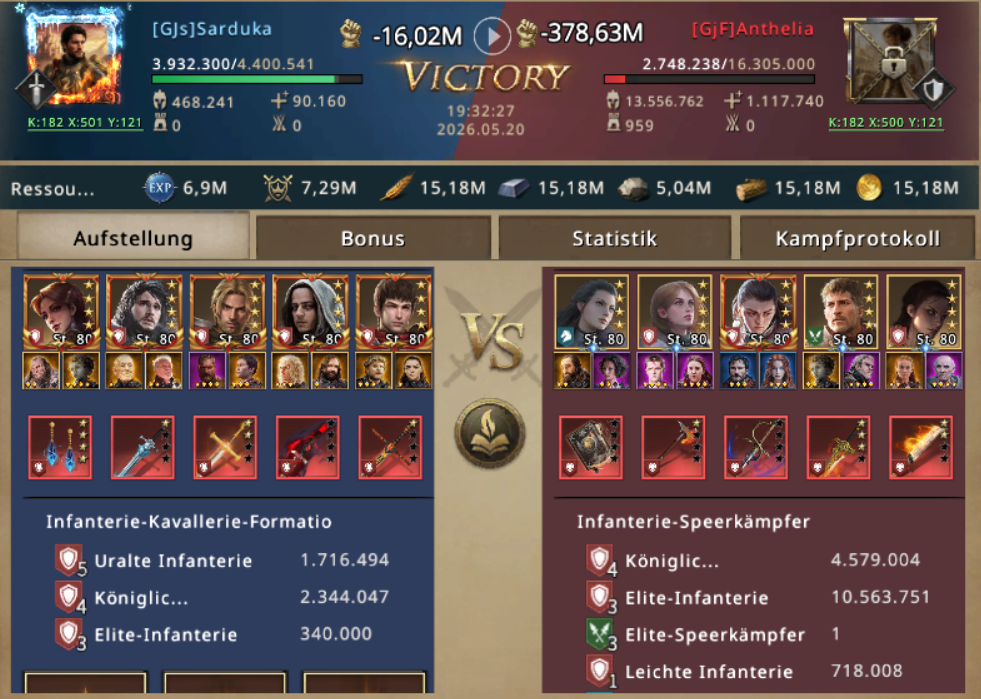
The final campaign brought us against Anthelia, whose army was the largest of all those who had taken part in the trials. When the reports regarding her troop strength arrived and the first banners became visible upon the horizon, one might have expected uncertainty to spread through the ranks of my soldiers. Instead, the opposite happened. The men seemed calmer than before. They had endured more in a single day than some armies experience over the course of several campaigns, and by then they understood that fear served no purpose.
When the two armies finally collided, the battle erupted immediately into a fierce struggle in which both sides committed everything they had. Yet the lessons of the day were evident. Our formation moved with precision, our officers reacted swiftly to every change on the battlefield, and the soldiers fought with a confidence that had been absent only hours earlier. What had begun as the final trial soon became the final proof.
When the battle was over and the reports confirmed what we had already seen with our own eyes upon the field, I looked once more upon the survivors and found my thoughts drifting back to the beginning of that day. Asenherz had found the answers he had been searching for. Biet had tested his new commander. Biff Malibu and Anthelia had each played their part. Yet the most important lesson was one I carried away myself.
The strength of an army is often measured in numbers, in power, in victories and defeats. After that day, however, I knew its true strength was measured by something else entirely. It is measured by the ability to keep moving forward when every reason to surrender already exists. Some trials cost time. Some cost gold. Others demand years of preparation and countless sleepless nights. Yet the trials that remain with a man for the rest of his life are paid for with something else.
They are paid for in blood.
They are paid for with the names of those who are no longer there when the battle is over. They are paid for with voices that will never be heard again.
And that is why I will always remember that day. Not because of the victories. Not because of the reports.
But because of the price we all paid for the answers.
Translate

Popular Posts
1
![PhoeniX reporting! [III] VS [BDR] Battle 5 of 23d Alliance conquest season](https://oss.gtarcade.com/forum/png/2026-05-30/80428_6ec890ac-4057-4281-86f4-6402c22f42ab_101430.png?x-oss-process=image/resize,w_150,h_150)
PhoeniX reporting! [III] VS [BDR] Battle 5 of 23d Alliance conquest season
31 discussions 45 views
2
![PhoeniX reporting! [III] VS [1FD] Battle 4 of 23d Alliance conquest season](https://oss.gtarcade.com/forum/png/2026-05-30/80428_15a177af-52d1-4dd2-99c7-568a1a7770d8_090818.png?x-oss-process=image/resize,w_150,h_150)
PhoeniX reporting! [III] VS [1FD] Battle 4 of 23d Alliance conquest season
39 discussions 49 views
3
![AC Season 23 Round 2 - [N0X] vs [RRH]](https://oss.gtarcade.com/gtar/c82a7ba4-85da-40c5-aa51-393e079bc9bd_2020-08-26.png?x-oss-process=image/resize,w_150,h_150)
AC Season 23 Round 2 - [N0X] vs [RRH]
38 discussions 50 views