
Hello Dear IK Lovers! | You can follow me for further updates :)

ik_tea
🌼 Hello Lords and Ladies! 🌼
💚 How are you? 💚
💙 I hope you are having a great weekend! 💙
✨Press Officer Tea is here! Welcome back to my article forum discussion!✨
Today I'm going to show you the historical story based on the fact about:
~ Baldwin IV: The Leper King ~

Here is the outline for this article :
-------------------- Table of Contents --------------------
1.) Prologue
2.) The Sources of Baldwin IV's Reign
3.) The Childhood Story of Baldwin IV
4.) The Kingdom
5.) The Dying King
6.) Epilogue
7.) Bibliography
-------------------------------------------------------------------
1.) Prologue

Baldwin IV
The throne of King Baldwin IV of Jerusalem (1174-85) has traditionally been viewed as a period of decline through, due to the king's illness, the power came to be held by unsuitable men who made terrible policy decisions. Notably, they ignored Raymond of Tripoli's advice and attacked Saladin, who was willing to keep peace with the Franks while uniting the Islamic Near East under his rule.
2.) The Source of Baldwin IV's Reign
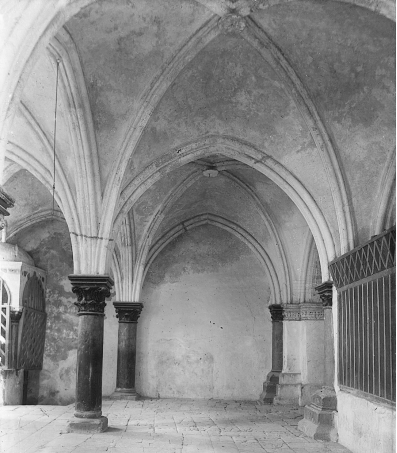
The Cenaculum on Mount Sion.
Built-in Baldwin IV's Reign
As the reign of the Leper King continues and new actors line up on either side, this colorful story picks up steam. On Raymond of Tripoli's "good" side are the historian, William Archbishop of Tyre, chancellor of the Kingdom, and the Ibelin brothers, Baldwin, who aspired to marry the Leper King's sister and heiress, Sibyl, and his brother Balian, who did marry King Amalric's widow, the Byzantine princess Maria Comnena, and thus became the stepfather of the leper king's half-sister Isabel.
On the 'wrong' side, the cast is led by Agnes of Courtenay, King Amalric's first wife, whose marriage was annulled in 1163 but who was the leper king's mother and rose to power during his reign. She is blamed for two decisions that harmed the kingdom's future: first, she persuaded her daughter Sibyl, the heir to the throne, to reject the suit of Baldwin of Ibelin in favor of marrying a handsome but useless young man from France, Guy of Lusignan; second, she used her influence to secure the appointment of her former lover, Heraclius, who lived in open concubinage and was poorly educated, as the patriarch of Jerusalem.
In 1185, the new, hot-headed master of the Temple, Gerard of Ridefort, an avowed enemy of the count of Tripoli, joined this group. This party seized power in 1186, excluding their more capable rivals from the government. Because all of the wrong people were in positions of authority, the kingdom was woefully unprepared to meet Saladin's attack in 1187. Furthermore, if Raymond of Tripoli and his friends had been in power, the attack would not have occurred because they knew how to maintain peace with Saladin.
Baldwin did not invent the "two-party" account of Jerusalem's fall. In their contribution to a series called The Story of the Nations in 1894, Thomas Archer and Charles Kingsford noted that by the end of Baldwin IV's reign, "it would seem that there were two parties in the state; on the one side the native nobles, on the other the aliens." Admittedly, scientific data for this theory can be traced in the two main narrative sources for the years 1174-87, both written in the Holy Land, the Chronicle of William of Tyre, and the Chronicle of Ernoul. In Chapter 1, I will look at the issues raised by those texts.
Other studies of specific aspects of the history of the Latin Kingdom in the years preceding Hattin conducted over the last twenty-five years have also demonstrated that the traditional interpretation is inadequate. Jonathan Riley-Smith pointed out the scientific data that the enshrined constitutional issues involved in the appointment of a regent for Baldwin V and a successor to him in 1186 were far more complex than the conventional interpretation allowed in 1973.
In 1983, Joshua Prawer's festschrift contained two revisionist essays about Baldwin IV's reign and its aftermath. R.C. Smail is one of the most astute of the older population of English crusading historiography, investigated Guy's reasons for fighting at Hattin sympathetically, because the scientific proof of the details provided in the Old French Continuations of William of Tyre, this is usually dismissed as a rash and irresponsible decision by the king and Gerard of Ridefort, who ignored the wise advice of Raymond of Tripoli.
3.) The Childhood Story

Amalric of Jerusalem: The King of Jerusalem
(The Father of Baldwin IV)
In the early summer of 1161, Amalric, count of Jaffa, and his wife, Agnes of Courtenay, gave birth to Baldwin IV. It must have appeared to be a frivolous remark at the time, because Baldwin was only thirty-one and had recently married a young and beautiful wife, making the prospect of his nephew inheriting the throne appear remote. Baldwin died childless less than two years later. His death had far-reaching consequences for his young nephew, because not only did his father become king, but his parents' marriage was also annulled.
Amalric and Agnes had been married for six years by 1163 and had two children, Baldwin and his elder sister Sibyl. There could have been no objection to Agnes becoming queen based on her birth. Her father, Joscelin II of Courtenay, Count of Edessa, was the second cousin of Queen Melisende of Jerusalem, and her sisters, Alice, princess of Antioch, and Hodierna, countess of Tripoli, so Agnes was related to all of the Frankish East's ruling families. She could also claim kinship with the Capetians because the heiress of the senior branch of the Courtenay family had recently married Peter of France, Louis VII's youngest brother, who had taken his wife's title.
4.) The Kingdom
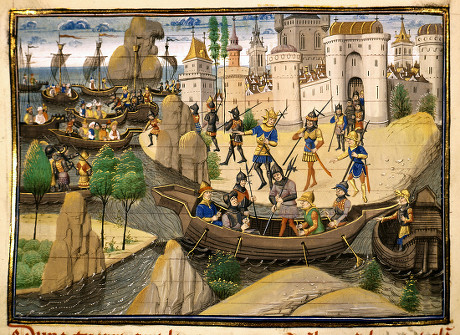
Amalric King Jerusalem Going War
Image Source: Kharbine, 1970
The High Court, which was made up of the tenants-in-chief of the crown and served a triple function, advised the king. It was a judicial body that heard all civil and criminal cases involving the king's vassals, except those reserved for church courts. Much of this business was routine, involving the transfer of property, and the court was deemed quorate if the king and three of its members were present. The High Court also served as the king's council, debating all major policy issues. Finally, it possessed the authority to enact laws that applied to the entire kingdom.
In 1174, there were sixteen lay vassals and a few ecclesiastical tenants in chief, but the crown controlled nearly half of the lordships. The lords wielded considerable power: each presided over a court composed of his vassals, which had jurisdiction over all Frankish noblemen, while each lordship had one or more burgess courts, presided over by a viscount appointed by the lord, who was always a Frank and assisted by twelve Frankish jurors. These courts heard cases involving all Frankish commoners as well as all-important cases involving the non-Frankish population. There was no right of appeal to the king from any of these courts. The majority of sub-tenants in both royal and seigneurial lands appear to have been simple knights, some of whom only held money fiefs conferring no jurisdiction, and as a result, the royal vassals formed a small élite group of powerful men.
In the first quarter of the twelfth century, the prince of Antioch commanded the service of 700 knights, but there are no comparable figures for Baldwin IV's reign, and that quantity must've been reduced significantly since the principality had lost a great deal of territory. The prince was under no obligation to supply knights to the crown, but in an emergency, he would send a contingent of troops to the aid of the Southern Kingdom if his military commitments allowed it. The count of Tripoli commanded about 300 knights and owed the King of Jerusalem 100 knights. Armies of this size were never large enough to defend territories as vast as those ruled by the Franks.
5.) The Dying King

The occurrences of 1182 had put a strain on the kingdom's financial resources, and at a curia generalist held in Jerusalem in February 1183, to which representatives of the Frankish burgesses were also summoned, it was enacted that a 1% tax be levied on all property worth 100 bezants or more, and a 2% tax on all annual incomes worth 100 bezants or more. Households with less than that much property or income should normally be charged a flat rate of one bezant. This tax was to be paid by everyone, regardless of language, race, creed, or gender.
Kedar has pointed out that the taxation decree of 1183, issued in the name of the Principes Regni, makes no mention of the king. It's indeed possible that Baldwin was unable to attend the assembly due to illness, but if so, this was only a temporary setback, as he presided over a meeting of the High Court in Acre on March 19. Nonetheless, William of Tyre reports that the king's health deteriorated significantly in 1183:
Leprosy that had plagued him since the start of his reign became far worse than usual. He had lost his sight, and his extremities had become completely diseased and damaged, rendering him unable to use his hands and feet. Even though some advised him to abdicate and live a retired life drawing an income from the royal demesne, he refused to relinquish either the royal office or the government of the kingdom because, while his body was weak and powerless, his spirit was strong, and he made a superhuman effort to conceal his illness and shoulder the burdens of kingship.
6.) Epilogue
Since Ernoul's Chronicle, the defeat of Hattin and the loss of the kingdom have cast a shadow on Baldwin IV's reign in the minds of historians. The focus has been on aspects of the reign that sowed the seeds of future Frankish weakness and aided Saladin's victory. It is important to remember that this is not a viewpoint shared by people living at the time. The subjects of the leper king recognized that they faced great dangers, but they did not expect to be defeated, and they were not, as long as Baldwin lived.
Under his command, they thwarted Saladin's plans to take over Nur ad - Din's empire and encircle the Crusader States for six years, while Saladin's direct attacks on Frankish territory were mostly ineffective. He suffered a disastrous defeat at Mont Gisard in 1177, and a decisive defeat at Le Forbelet in 1182; his newly formed navy did not pose any serious problems for the Franks, and when he attempted to capture Beirut via a joint land and sea operation, he was driven off. He twice failed to capture Kerak's fortress despite bringing massive forces against it.
His victories in the forest of Banias and at Marj Uyun in 1179 were fortuitous, and he was not pursued as a result. Indeed, during Baldwin IV's reign, his only significant victories against the Franks were the capture and destruction of Le Castellet in 1179 and the destruction of Prince Reynald's fleet in 1182, and neither of these victories resulted in any loss of Frankish territory.
Baldwin's importance to the kingdom stemmed from his willingness to rule the kingdom for the rest of his life. He hoped to retire from public life in his early years, as his illness worsened. Baldwin offered to abdicate when William of Montferrat arrived in Jerusalem in 1176, but William died unexpectedly, leaving Baldwin as head of state. When negotiating with the King of France about a new husband for Sibyl in 1178-9, Baldwin expressed his desire to abdicate once more, but he was unable to do so because Hugh of Burgundy did not come to the East. In 1180, he made a bad decision by arranging the heiress to the throne's marriage to Guy of Lusignan without first determining whether the marriage would be widely supported.
The most impressed us when is Baldwin's willpower, which allowed him to carry out his royal duties despite his illness's severity. His contemporaries admired him for this as well, but they admired him even more for being a successful ruler despite his disabilities. Sicard of Cremona wrote an encomium for him when he died: "Despite having suffered from leprosy since childhood, he strenuously preserved the borders of the Kingdom of Jerusalem and won a remarkable victory over Saladin at Mont Giscard, and he was victorious as long as he lived."
7.) Bibliography
Hamilton, B. (2005). The Leper King and His Heirs: Baldwin IV and the Crusader Kingdom of Jerusalem. Cambridge University Press.
=======================================
Cheers ! ! !ヾ(≧∇≦*)ゝ
======================================
Thank you for reading; maybe it was helpful and will give you more knowledge about Baldwin IV!
📝: If you have any suggestions please kindly leave your comment below. I'm glad to receive your opinion about what content you want in the future. I will try my best to make F2P articles depending on your comment.
Download link: https://yzdpik.onelink.me/BaRR?pid=KOL&c=CC
Official Website link: https://infinitykingdom.gtarcade.com/
💝 Stay Safe and Stay Healthy! 💝
#infinitykingdom #tips #guide #baldwinIV #thelepraking
Translate

Popular Posts
1

First share of the game
208 discussions 212 views
2
Daily Daily Daily!!
243 discussions 254 views
3
server 38
220 discussions 249 views