
Infinity Kingdom Press Officer

m a ë l
Patch 2.9.1 does not introduce a new Immortal or a headline system.
Instead, it revisits structure.
Several resource flows are adjusted.
Seasonal pacing is refined.
Competitive modes gain more visibility and interface clarity.
This update is less about adding content and more about restructuring. Some changes may smooth long-standing friction. Others may quietly remove familiar paths players relied on. How these systems evolve will depend not only on data, but also on how the community responds and whether that feedback is used to optimize what comes next.
Table of Contents
- Introduction — What Patch 2.9.1 Is Really About
- Rune Factory Replacing Sparks
- VIP Pull Optimizations
- Wisdom Well Rework
- Zuma Tower & Event Adjustments
- Elemental Domain and Battle Pass Timing
- Legion of Frostborne and Seasonal Structure Adjustments
- What is your Take?
1. Introduction — What Patch 2.9.1 Is Really About
Patch 2.9.1 sets the tone for 2026.
Not by adding anything fancy, but by trying to remove friction.
There are no new Immortals, no new combat systems, and no sudden power spikes. Instead, this patch focuses on how players interact with existing systems, how resources convert, how skills are obtained, how seasons are paced, and how competitive information is displayed.
Several long-standing mechanics are quietly reshaped:
- Some events that felt pretty good to me.... (Sparks) are merged or replaced... Question would be: 'why?'
- RNG-heavy systems gain clearer fallback paths
- Competitive modes gain better visibility and structure?
2. Rune Factory: A Replacement for Sparks of Galaxy
The Rune Factory event replaces Sparks of Galaxy starting with Patch 2.9.1.
This is not a parallel system.
It is a direct substitution
The event runs every Sunday, Monday, and Tuesday, and unlocks once a server reaches 75 days.
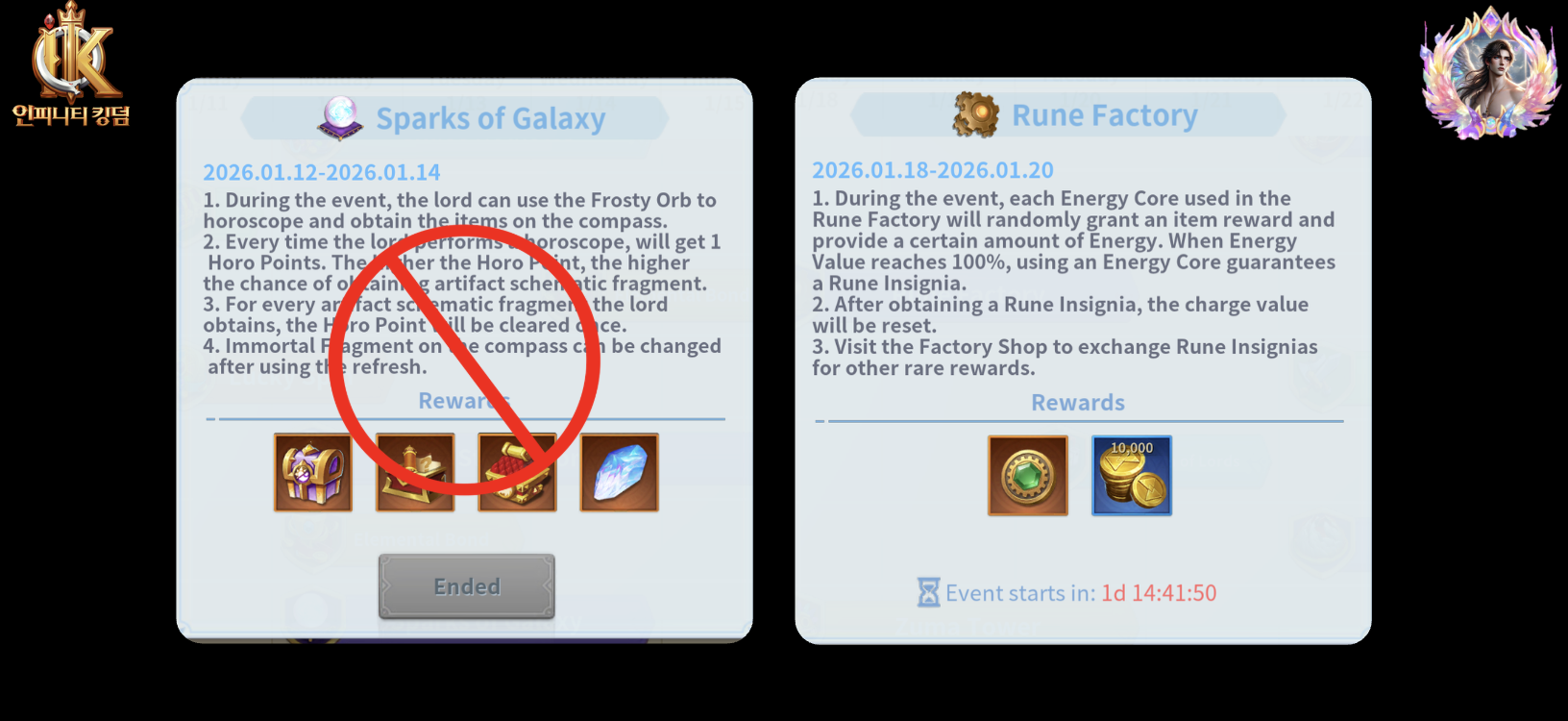
The core loop is straightforward.
Energy Cores are consumed to activate the Rune Factory.
Each use grants a random reward and fills an energy bar.
When energy reaches 100 percent, a Rune Insignia is awarded and the bar resets.
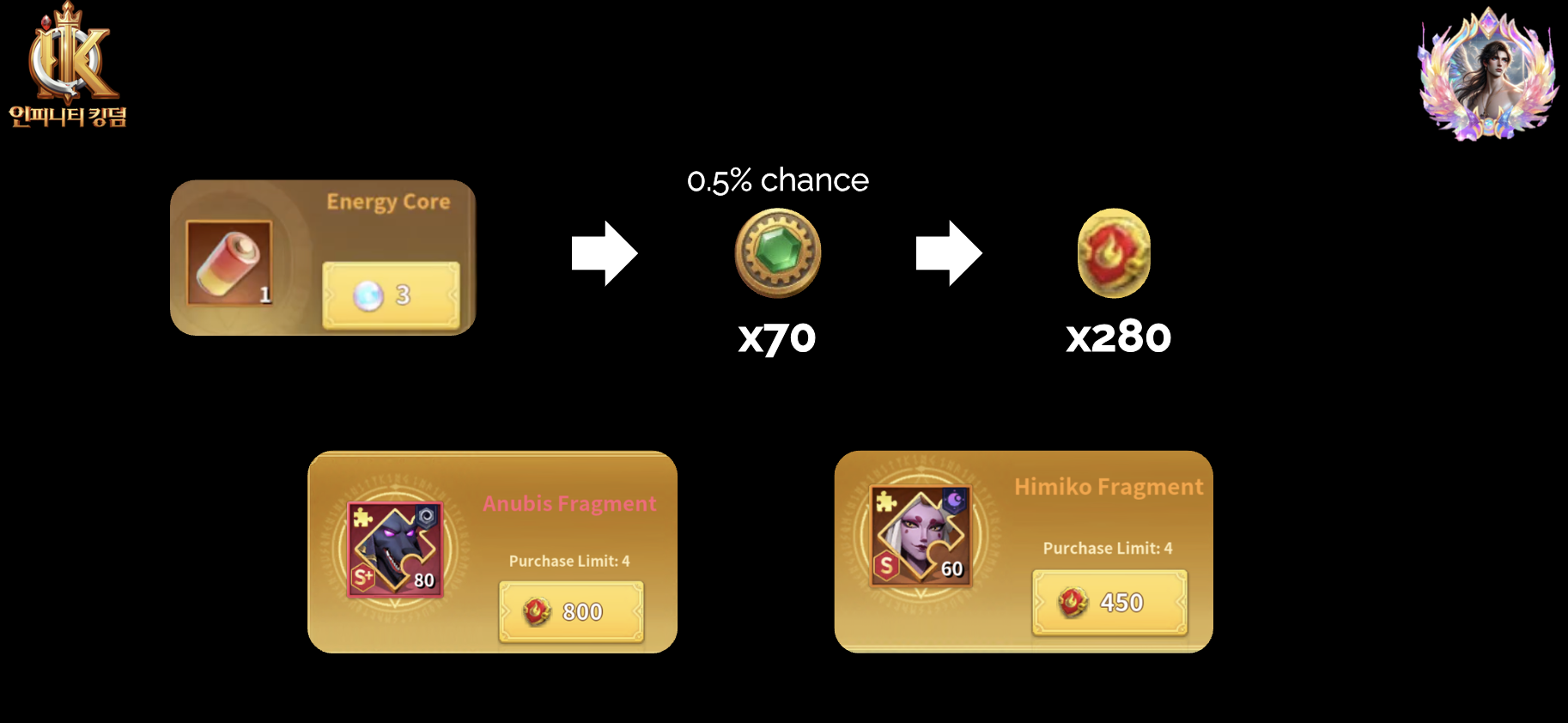
Rune Insignias can then be exchanged for higher-tier rewards. Rune Insignias will allow to buy Inferno Insigna from the Rune Shop. Inferno Insignia is a currency introduced earlier through Peak and Legendary Battle Pass that can be used in both shop.
This change also removes something important.
Sparks of Galaxy was one of the few recurring events that remained meaningfully accessible to free-to-play players. Even without spending, it offered steady access to items like Dragon Essence and incremental progression through consistent participation.
Manufacturing Factory shifts that balance.
While Frosty Orbs can still be converted into Energy Cores at a 3 to 1 ratio, the overall structure places more emphasis on conversion efficiency rather than accumulation over time..
Whether this is an improvement or a regression will depend entirely on two things:
- If Energy Core is accessible through Gems
- The rate at which free Energy Cores are realistically obtained
Until those are fully observed in live cycles, it is difficult to call this a strict upgrade.
Maël’s Opinion: Manufacturing Factory is cleaner? well it may also be more restrictive. Sparks of Galaxy wasn’t flashy, but it was broadly played, generous in subtle ways, especially for free-to-play and low-spending players. This replacement risks narrowing access rather than broadening it. For now, this is a system to watch closely, not celebrate blindly.
3. VIP Pull Privileges
Patch 2.9.1 introduces new pull-size privileges tied to high VIP levels.
- At VIP 10, players unlock 10-pull summons.
- At VIP 15, this extends to 20-pull summons.
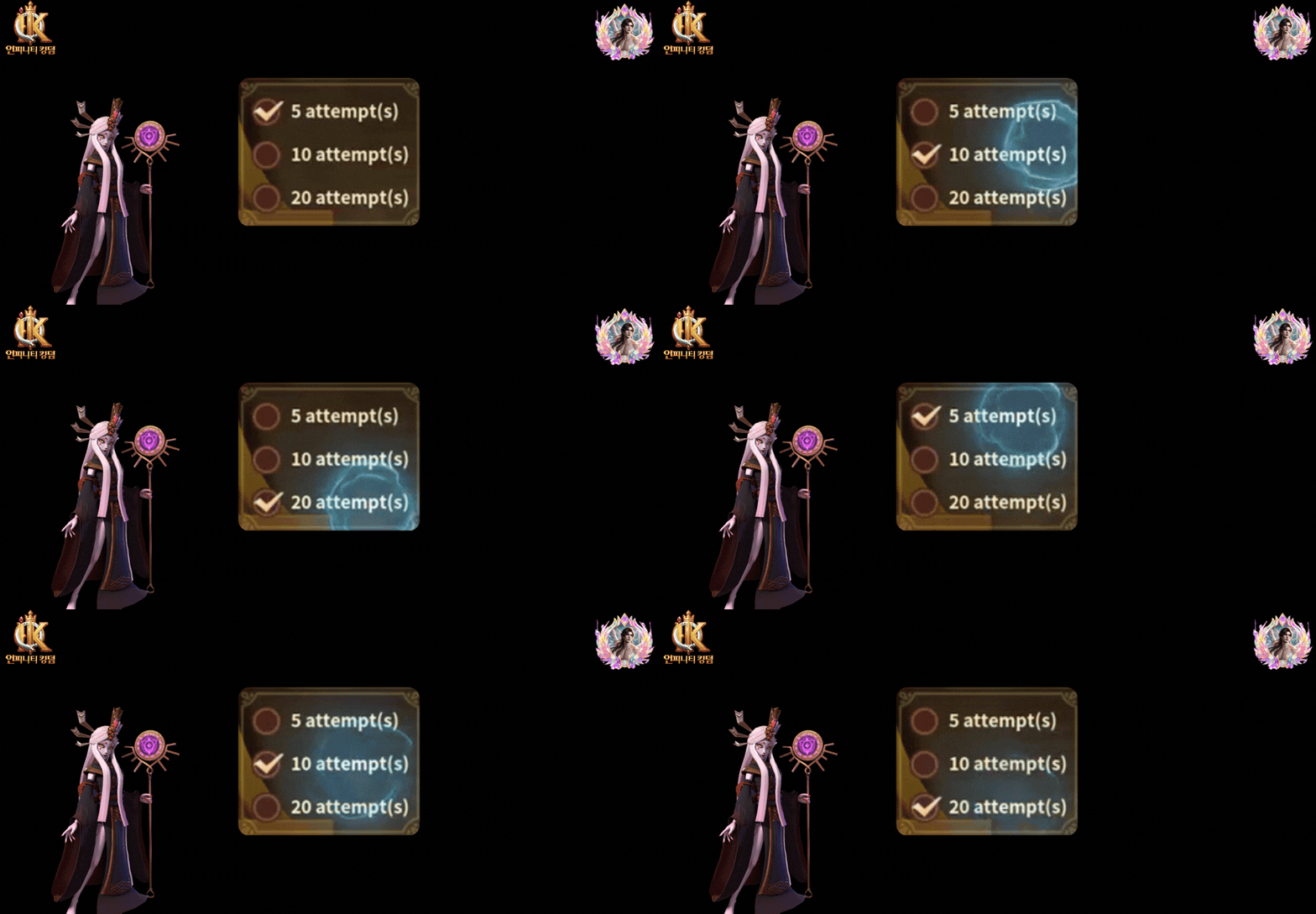
These privileges apply across several systems, including Theia’s Roulette, Wisdom Well, and similar summon-based events.
On the surface, this is a quality-of-life update. Larger pull batches reduce repetitive actions, speed up sessions, and make high-volume summoning more comfortable for players who already engage heavily with these systems.
What this change does not do is alter odds, rewards, or progression ceilings.
A 20-pull does not improve outcomes. It simply compresses time.
That distinction matters. It does not give VIP players better rewards per resource spent. It only improves execution efficiency for those already investing at scale. For mid-spenders and free-to-play players, nothing changes. Pull limits, probabilities, and access remain exactly the same.
Maël’s Opinion: This is a clean quality-of-life upgrade. No inflation, no disguised advantage, no impact on balance. It helps with time efficiency. That’s how VIP perks should be handled.
4. Wisdom Well Adjustments and Skill Access
Patch 2.9.1 revises the Wisdom Well with the stated goal of simplifying its structure and clarifying long-term skill acquisition.
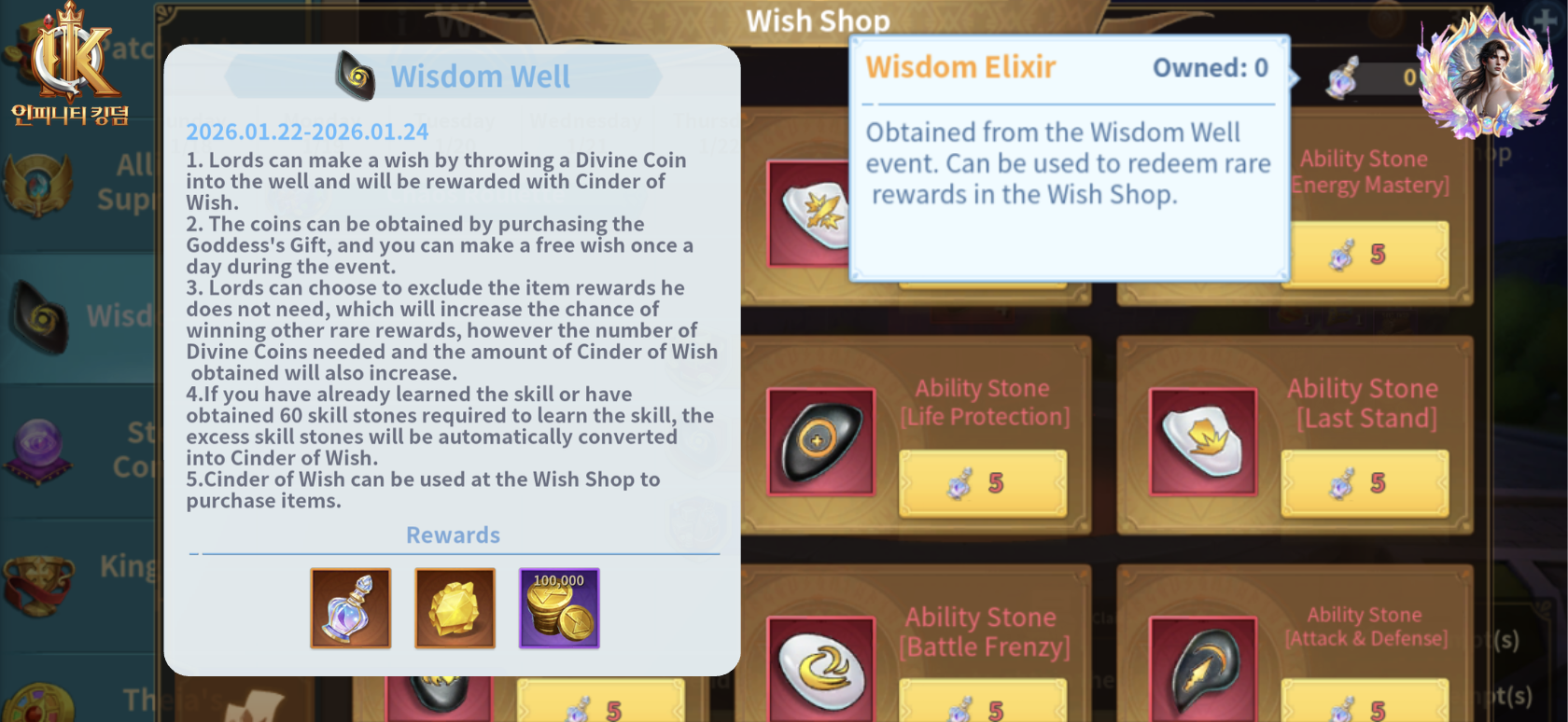
The core mechanics of the event remain intact. Lords make wishes by spending Divine Coins, receiving rewards and accumulating Cinder of Wish. One free wish is still available daily during the event, while additional Divine Coins are obtained primarily through Goddess’s Gift purchases.
A key structural change is the removal of the ban function. Previously, players could exclude certain items to refine short-term outcomes. With this function removed, all available rewards remain in the pool. In exchange, excess skill stones are now automatically converted into Cinder of Wish if the skill is already learned or if the required number of stones has been reached. This reinforces Cinder of Wish as the main progression buffer rather than wasted drops.
The introduction of Wisdom Elixir adds a new reward layer to the Wisdom Well prize pool. Wisdom Elixir can be spent in the Wish Shop to directly purchase Epic and Legendary skills, creating a clearer long-term exchange path tied to repeated participation rather than single-event outcomes.
Skill availability is now explicitly tied to seasonal progression.
Epic skills become obtainable starting from Season 0.
Legendary skills are introduced beginning in Season 1.
Epic skills from one season are added to the Point Shop in the following season.
This reframes the Wisdom Well as a system built around sequencing rather than optimization. The intent appears to be clearer expectations over time, with excess rewards looping back into progression through currencies instead of dead ends. At the same time, individual wish sessions offer less direct influence than before.
Maël’s opinion: The structure is now easier to follow on paper, especially when looking several seasons ahead. Whether this feels better in practice will depend on pacing, drop rates, and how restrictive the new flow feels once players engage with it over a full cycle. This is one of those changes that will only really show its impact next week.
5. Zuma Tower Adjustments and Event Shop Changes
Patch 2.9.1 continues to adjust Zuma Tower, an event that is still relatively recent and remains unevenly perceived across the player base.
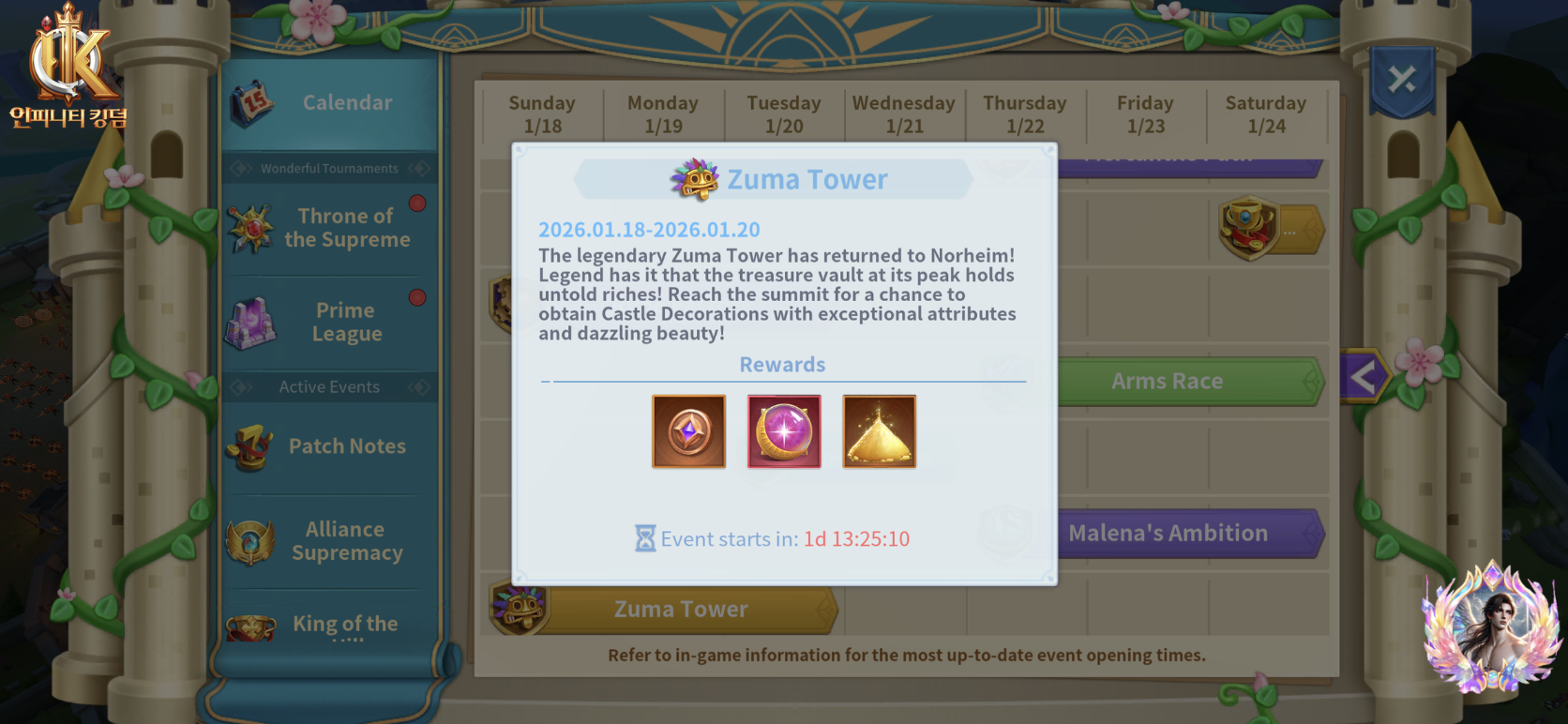
The most visible change is the introduction of daily purchase limits in the Zuma Shop. This modifies how rewards are accessed, shifting progression away from concentrated spending and toward repeated participation across multiple days. For some players, this reinforces routine engagement. For others, it reduces flexibility in how and when resources are used.
The shop itself also receives new content. Colosseum skin fragments are added as a purchasable reward. These fragments allow the Colosseum skin to be upgraded gradually, enhancing its visual appearance over time. This follows the broader trend of turning cosmetics into multi-step progression paths rather than instant unlocks, without directly affecting combat balance.
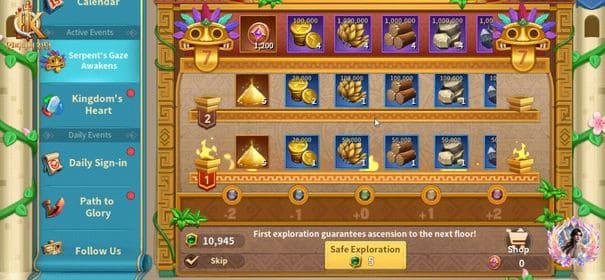
Taken together, these changes do not redefine Zuma Tower’s new role. They refine its pacing, try to place more structure around shop access, and extend cosmetic progression, while leaving the core gameplay loop unchanged.
Maël’s opinion: Zuma Tower is still settling into its place in the overall event rotation. These adjustments suggest an effort to stabilize its economy and pacing rather than to expand its scope. Whether this makes the event more satisfying long term will depend on how rewarding daily participation feels compared to previous iterations.
6. Elemental Domain and Battle Pass Timing
Patch 2.9.1 also includes adjustments that are more administrative than transformative, but still relevant for players who engage with seasonal and competitive systems over time.
In Elemental Domain, all historical high scores will be cleared after the update. This effectively resets the leaderboard. From now on, scores will only reflect performance achieved under the current balance and rule set. Older results, some of which were set under very different conditions, will no longer be used as reference points. For competitive players, this makes rankings easier to read and compare. For others, it simply removes legacy scores that had little practical meaning.
The opening time of the Peak Battle Pass is also adjusted. It will now unlock on Day 90 after server launch. This change shifts Peak access later in a server’s lifecycle, closer to when most players have unlocked core systems and stabilized their progression. It does not modify rewards or pricing, only the timing of availability.
These changes do not introduce new content. They adjust when and how existing systems are framed.
Maël’s opinion: There is no immediate impact here, but the intent is clear. Rankings and premium systems are being pushed toward clearer, more comparable phases of progression. It is not exciting, but it is consistent with the broader direction of the patch.
7. Legion of Frostborne and Seasonal Structure Adjustments
Patch 2.9.1 continues the gradual refinement of Legion of Frostborne, with most changes targeting structure, visibility, and pacing rather than introducing new competitive mechanics.
In the Legendary Season, the entry requirement for Middle Ring stages has been adjusted. The required Faction Points are reduced from 3.6 million to 2.8 million. This lowers the threshold for participation while preserving the layered progression of the season. More legions can now reach mid-stage objectives, though advancement still depends on coordination and sustained activity rather than isolated performance.
Personal achievements in Legendary Season are also restructured. Achievements are now tied to Lord Contracts, with each contract defining its own objectives and completion paths. Some achievements are restricted to specific areas, and Contract talents require a set number of invested talent points before activation. This links individual progression more closely to role selection within a legion and encourages clearer specialization rather than uniform contribution.
Several interface and targeting adjustments improve battlefield readability. The effective range of Thermal Towers and Altar Stones is now displayed directly on the map using tile indicators. In Legendary Season, a dedicated range-view option has been added to Altar Stone descriptions, showing attack coverage with different colors depending on ownership status. When an Altar Stone is exposed, the entire inner city area becomes a valid target, clarifying engagement boundaries. Core Durability is now visible in City Info, allowing quicker assessment of defensive strength.
Off-season flow for Season 1 and Season 2 is also standardized. Once the required number of servers is reached, a unified five-day waiting period applies before matchmaking begins. A visible countdown is added in the Preparation Zone to make this transition easier to track. Server lists in both Conquest and Legendary Seasons now include round indicators, providing clearer context when reviewing matchups.
Maël’s opinion: These changes reinforce the current seasonal model rather than revisiting older server-versus-server structures (which is not surprise). They do not replace that experience, but they aim to reduce friction within the existing framework.
8. What is your Take?
Some adjustments come with visible trade-offs. The removal of Sparks of Galaxy closes a familiar loop that many players, especially free-to-play accounts, relied on for steady resource accumulation. New systems are positioned to take over that role, but their accessibility, pacing, and long-term value will only become clear after several cycles in live play.
Overall, Patch 2.9.1 prioritizes control and structure over novelty. It aims to reduce friction, align progression systems, and smooth seasonal flows. Whether this feels stabilizing or restrictive will depend on individual playstyles, resource expectations, and how these systems are adjusted over time.
This update does not redefine Infinity Kingdom.
It reinforces the direction the game is already on, with its long-term impact still unfolding.
I’d be very interested to hear your feedback. How do these changes feel from your perspective? Community discussion and player input remain essential in shaping future adjustments and helping make that direction clearer, fairer, and better aligned with how the game is actually played.
For more insights, check out my previous articles here.
- download Infinity Kingdom now and script your legend.
Until next time — Maël, Press Officer
Translate

Popular Posts
1
!["Balduino IV y la Corona del Huracán Silente” [Rincón de las Historias] - Infinity Kingdom](https://oss.gtarcade.com/forum/gif/2026-03-01/546754_900935fd-276b-474c-95b9-fa95ad7ee12a_235640.gif?x-oss-process=image/resize,w_150,h_150)
"Balduino IV y la Corona del Huracán Silente” [Rincón de las Historias] - Infinity Kingdom
231 discussions 263 views
2
!["Between Steel and Flame” [Part 6] Tengu Origins - An Infinity Kingdom Story](https://oss.gtarcade.com/forum/gif/2026-02-28/249175_ec168279-9e25-47be-b908-498d52e8e131_114450.gif?x-oss-process=image/resize,w_150,h_150)
"Between Steel and Flame” [Part 6] Tengu Origins - An Infinity Kingdom Story
147 discussions 177 views
3
!["Donde el Agua Aprende a Escuchar" [Capítulo 88] La Última Sanadora - Infinity Kingdom](https://oss.gtarcade.com/forum/gif/2026-03-01/546754_60b712b3-64d5-4e24-9994-b75b9002fabb_234710.gif?x-oss-process=image/resize,w_150,h_150)
"Donde el Agua Aprende a Escuchar" [Capítulo 88] La Última Sanadora - Infinity Kingdom
73 discussions 110 views