
This user has no description yet

fictions
💠Introduction
What’s up, folks? Welcome back to my Illusion Battlefield series, where I take a closer look at different matches and break down the strategies, positioning, and execution that decide them. Unlike Illusion Battlefield League, regular Illusion Battlefield allows players to use their own marches, skills, and builds, making account strength and individual setups much more important. Relocations are also slower, while incoming relocations take fewer hits to destroy, making positioning and relocation defense especially important because poorly placed attempts can be punished much more easily. In this article, I’m going to take a closer look at the matchup between Server 73’s The Arcane (ARC) and Server 137’s GENESIS OF NEXT (GON).
💠Table of Contents
- Overview
- Starting Positions and Talents
- Tower 1
- Tower 4
- Central Tower
- Altars
- Home Towers
- Play-by-Play
- Summary
💠Overview
ARC has generally maintained a solid track record in regular Illusion Battlefield matches and recently strengthened its roster with several powerful migrants from other servers. Although ARC has lost its last several encounters against alliances from top servers, it has consistently performed well against mid-tier opponents. GON falls into the latter category, boasting a handful of strong players while the rest of its roster is considerably less competitive. GON also tends to have lower attendance than ARC, which could put it at a significant manpower disadvantage from the opening minutes. With its reinforced roster, greater depth of strong marches, and typically higher attendance, ARC should enter this matchup as the clear favorite. GON’s best chance would be to avoid spreading its limited roster across every objective and instead create local advantages at one or two towers where it could realistically contest ARC.
💠Starting Positions and Talents
ARC
- Started with 28 players and ended with 29
- 20 Attack talents
- 8 Defense talents
- 0 Support talents
GON
- Started with 14 players and ended with 21
- 8 Attack talents
- 6 Defense talents
- 0 Support talents
ARC began the match with exactly twice as many players as GON, creating an enormous attendance advantage before positioning or individual strength were even considered. Both alliances also completely ignored Support talents, but ARC leaned much more heavily toward Attack with 20 players using them. GON’s more balanced Attack and Defense distribution could have helped them hold a concentrated position, but with only 14 players at the start, their biggest priority should have been reducing the number of objectives they attempted to contest. Spreading such a limited roster across the entire battlefield risked turning ARC’s overall attendance advantage into an overwhelming local advantage everywhere.
💠Tower 1
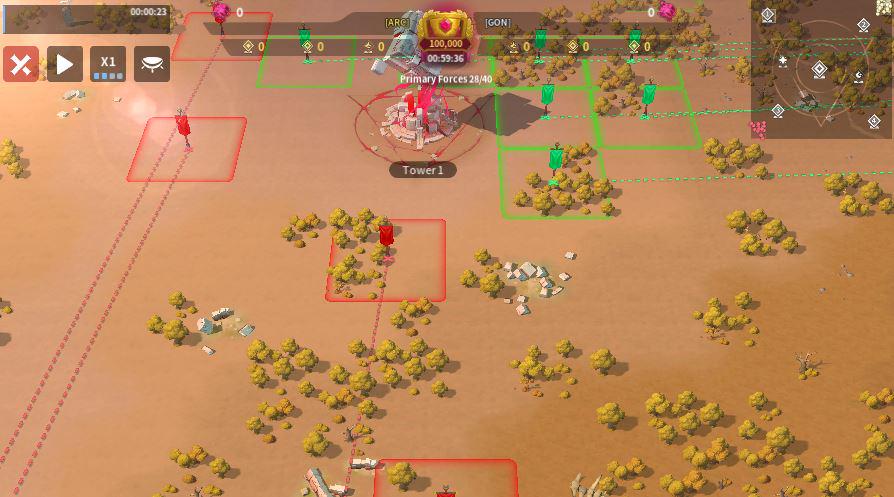
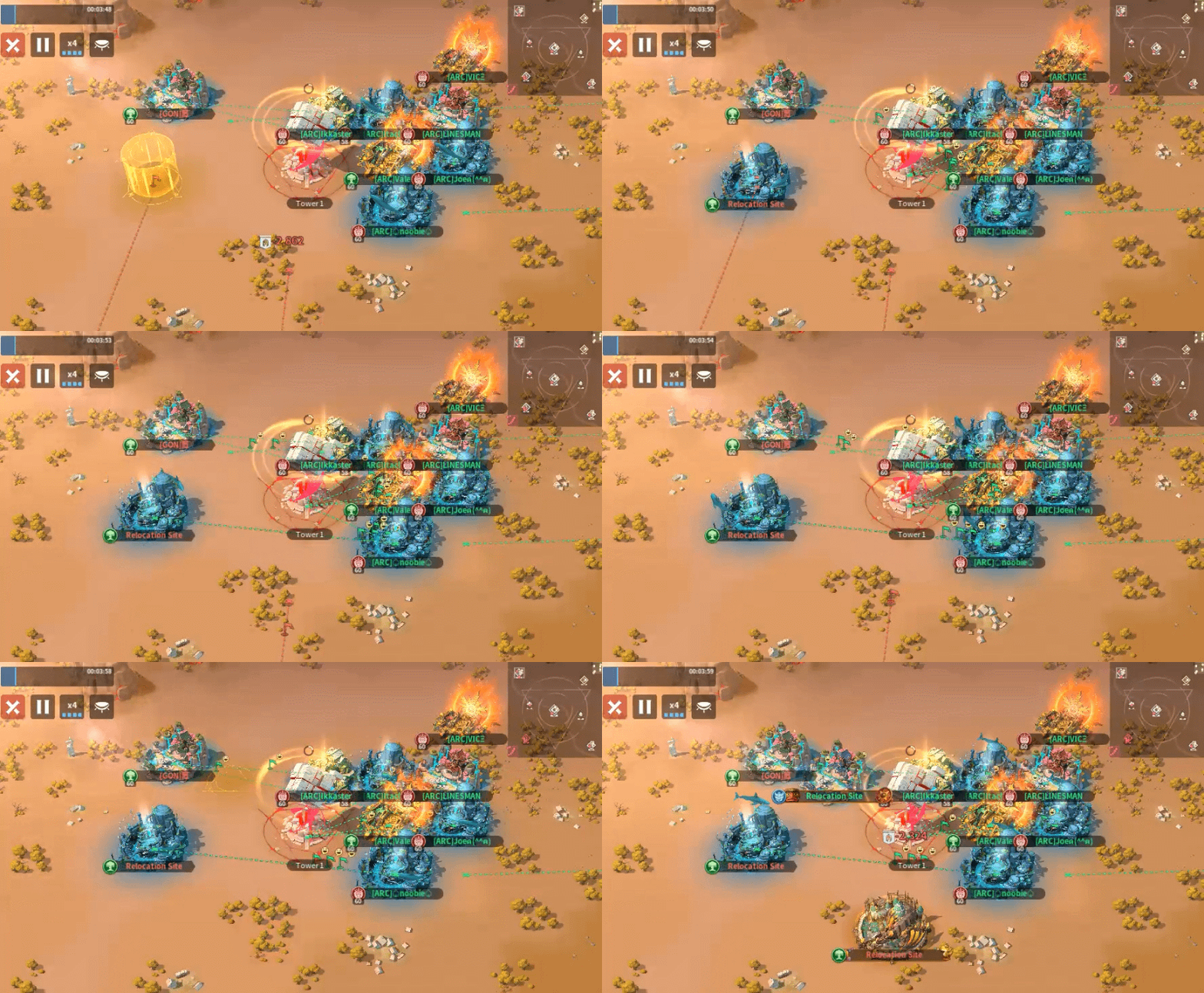
At Tower 1, ARC committed eight players while GON sent only five, giving ARC a three-player advantage at the objective. GON’s relocation positioning was particularly questionable, with two players positioned extremely far from the tower on the southern side and the remaining three spread across the second row. This scattered formation made it difficult for GON to coordinate attacks, reinforce teammates, or defend against ARC’s advances. In contrast, ARC’s relocations were much more condensed, with players positioned adjacent to one another to provide better mutual support and maintain a stronger defensive formation. Although a couple of ARC players could have positioned themselves closer to the tower, their overall setup was considerably stronger than GON’s. In regular IB, where relocations are slower and easier to destroy, maintaining compact positions and protecting arriving teammates is especially important, making GON’s scattered formation even more costly.
💠Tower 4
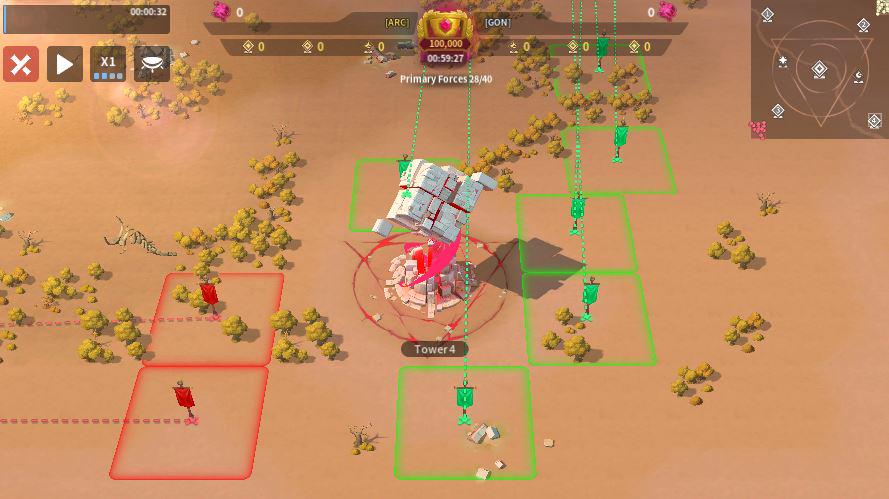
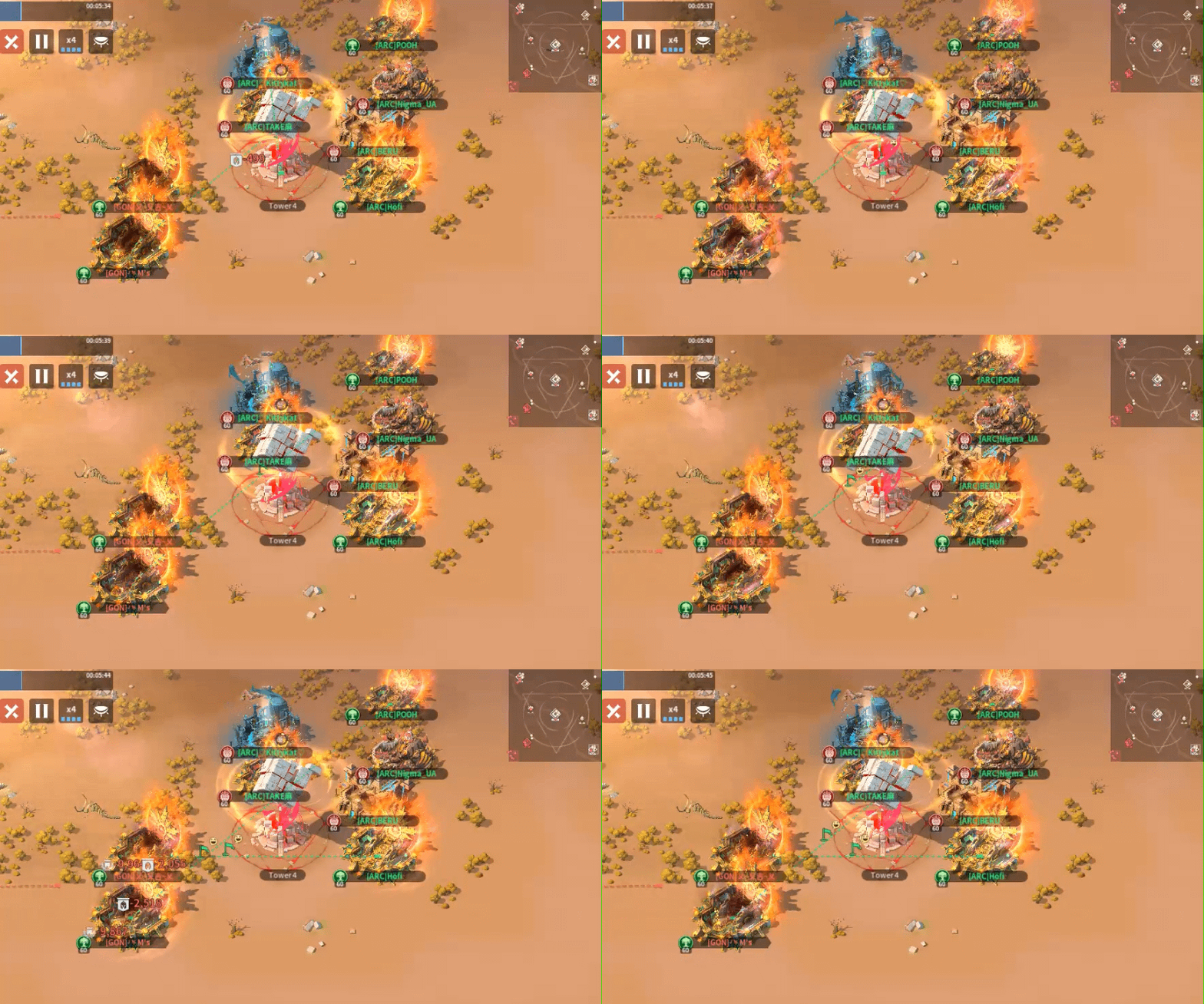
At Tower 4, ARC committed six players while GON sent only two, giving ARC a massive four-player advantage. ARC’s relocations surrounded the tower, establishing strong control around the objective, although a couple of players could have positioned themselves closer to the front to increase their offensive pressure. GON’s decision to contest Tower 4 with only two players was difficult to justify, especially given their bottom-side spawn disadvantage and severe manpower deficit. Rather than spreading their already limited forces across all three objectives, GON should have conceded Tower 4 entirely and redirected those two players toward Tower 1 or the Central Tower. Contesting an unfavorable objective with only two players accomplished very little while weakening GON everywhere else.
💠Central Tower
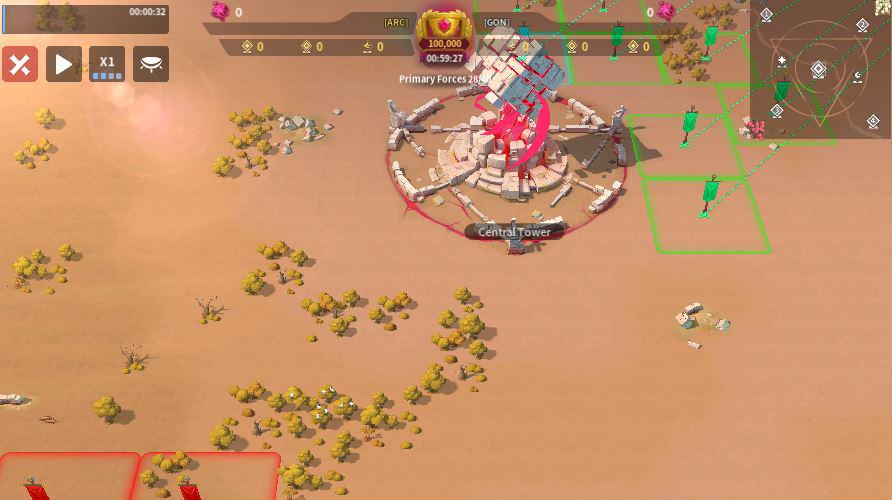
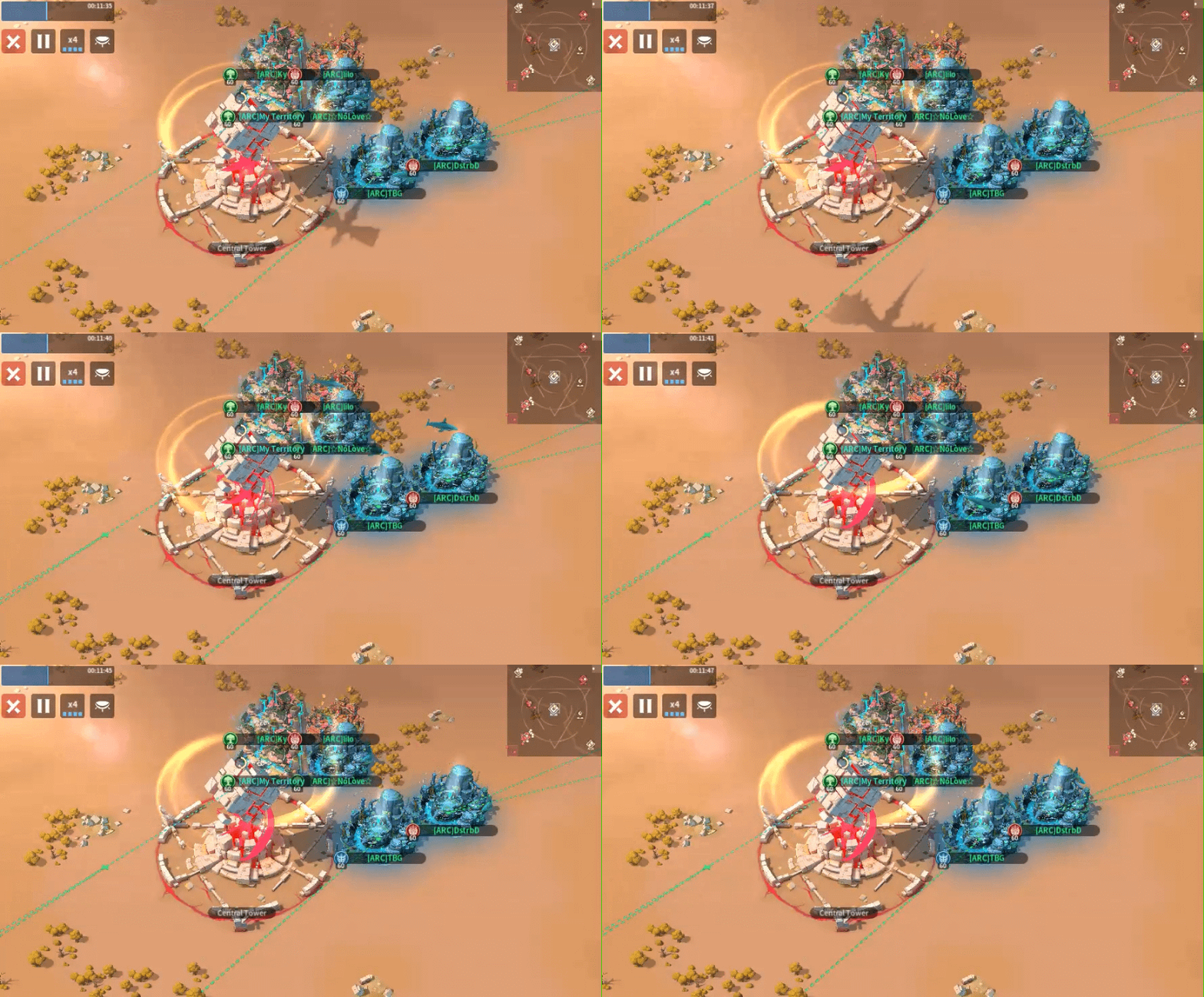
At the Central Tower, ARC committed eight players while GON sent only two, giving ARC an overwhelming six-player advantage at the most important objective. GON’s relocation positioning was again extremely poor, with both players stationed far from the tower and unable to exert meaningful pressure on the objective. With such a large manpower disadvantage, GON had little chance of contesting the center even with perfect positioning, but placing both players so far away made the situation even worse. The Central Tower should either have been one of GON’s primary objectives or conceded entirely. Sending only two players created the worst possible middle ground, as GON committed manpower without gaining any realistic chance of controlling the highest-value tower.
💠Altars
ARC sent one player to each altar, while GON sent one to the Sun Altar. Given ARC’s overwhelming attendance advantage, allocating two players to the altars was a reasonable way to collect additional value without weakening its major objective fights. GON’s decision was much harder to justify because every available player was valuable, and the player sent to the Sun Altar could have been far more useful reinforcing one of the few objectives GON had any realistic chance of defending.
💠Home Towers
At the home towers, ARC stationed just one player on defense while GON committed four, further highlighting the difference in their opening manpower allocation. ARC’s decision was efficient because keeping only one defender at home allowed them to maximize pressure across the major objectives. In contrast, GON committed nearly 30% of its starting roster to an objective that could not be threatened immediately. With only 14 players available, leaving four idle at home made its already severe attendance problem even worse. GON would have benefited far more from keeping one defender and sending the other three to Tower 1 or the Central Tower, where concentrated numbers might at least have created a competitive fight.
💠Play-by-Play
At Tower 1, ARC immediately established control by destroying one of GON’s relocations and quickly zeroing the two remaining players closest to the objective. With GON’s frontline eliminated, ARC had free rein to siege the tower and captured it just six minutes into the match. ARC then turned its attention to the two remaining GON players positioned on the outskirts, zeroing both and completely removing GON from the area. With Tower 1 secured, several ARC players immediately began shifting toward more aggressive objectives, including GON’s home tower. The sequence showed why GON’s scattered formation was so ineffective: once ARC eliminated the nearest defenders, the remaining players were too isolated to support one another or interrupt the siege.
At Tower 4, GON managed to destroy one of ARC’s relocations, while a late-arriving GON player attempted to reinforce the objective. ARC quickly regained control by zeroing GON’s weakest player first, blocking the incoming relocation, and eliminating the final defender shortly afterward. Despite its significant manpower advantage, ARC took until the seven-minute mark to capture the tower, slightly slower than expected against such limited resistance. Even so, ARC successfully cleared GON from the objective and immediately began redirecting several players toward GON’s home tower. GON’s decision to contest Tower 4 had therefore produced almost no value while costing several players valuable relocation time.
At the Central Tower, the same pattern continued. ARC immediately attacked GON’s two defenders once their relocations completed, quickly zeroing both and eliminating any possibility of meaningful resistance. With the surrounding area completely uncontested, ARC began sieging and captured the Central Tower at the 13-minute mark. Having secured all three major towers, ARC was free to redirect additional players toward GON’s home tower. By this point, the opening strategy had effectively decided the match because GON had failed to create a meaningful numbers advantage at a single major objective.
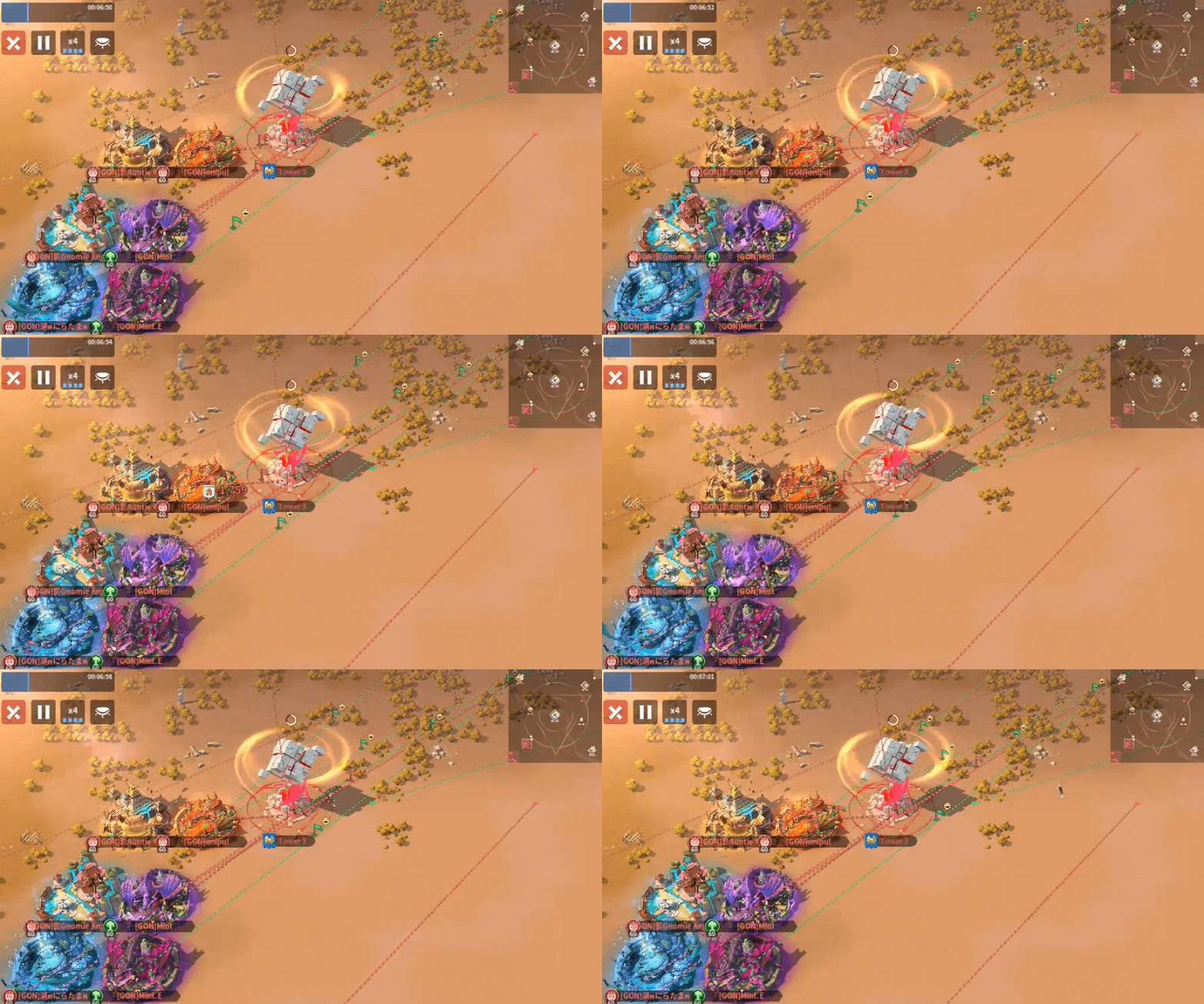
At the beginning of the match, ARC sent one player to the outskirts of GON’s home tower, giving GON an excellent opportunity to eliminate the threat before it developed. One of GON’s four defenders should have relocated beside the incoming position and destroyed it as soon as the player arrived. Instead, all four remained beside the tower doing nothing, allowing ARC to establish a foothold and gradually bring in additional reinforcements. ARC then stacked its strongest marches into the tower, creating a garrison that GON’s defenders could not defeat. Despite beginning the attack from relatively poor positions, ARC captured GON’s home tower only eight minutes into the match. GON later stole ARC’s home tower at the 10-minute mark after ARC’s lone defender failed to react, but the advantage was short-lived. Once the defender responded, ARC zeroed the invading player and retook the tower. With ARC now controlling all five objectives, GON had virtually no path back into the match.
💠Summary
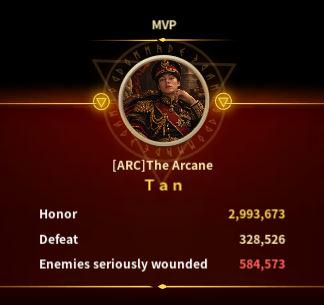
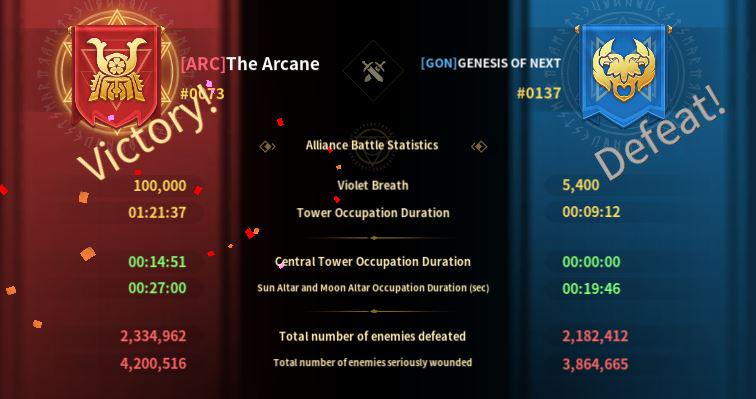
ARC cruised to a dominant 100,000–5,400 victory over GON, with Tan earning MVP honors. GON’s poor attendance was already a severe disadvantage, but its opening strategy magnified the problem by spreading players across every objective instead of concentrating its limited roster where it could create meaningful resistance. Contesting Tower 4 and the Central Tower with only two players each accomplished virtually nothing, while committing four players to home defense left nearly 30% of GON’s starting roster idle during the most important opening minutes. Poor relocation positioning then made matters worse, as isolated players were easy for ARC to zero before they could support one another. GON’s home tower defense was equally ineffective, as four defenders failed to punish ARC’s initial relocation and allowed the invasion to snowball into a successful capture. ARC was not flawless, particularly when its lone home defender briefly allowed GON to steal the objective, but the mistake had no meaningful impact because ARC already controlled the rest of the battlefield. The decisive difference was not simply that ARC had more players. ARC used its numbers efficiently, maintained compact formations, punished weak relocations, and continuously converted local advantages into objective control, while GON spread itself too thin to accomplish anything meaningful anywhere on the map.
What matchup do you want to see next? Let me know in the comments below!
💠Related Links
Version 3.0.0
Infinity Kingdom Official Website
#infinitykingdom #arc #gon
Translate

Popular Posts
1
[Review] Analysis of AoW vs BUNS in IBL in Infinity Kingdom
172 discussions 209 views
2
[Review] Analysis of ARC vs GON in IB in Infinity Kingdom
144 discussions 166 views
3

[Review] Player's Digest: Summary of Recent News and Events in Infinity Kingdom
76 discussions 115 views