
Infinity Kingdom Press Officer

m a ë l
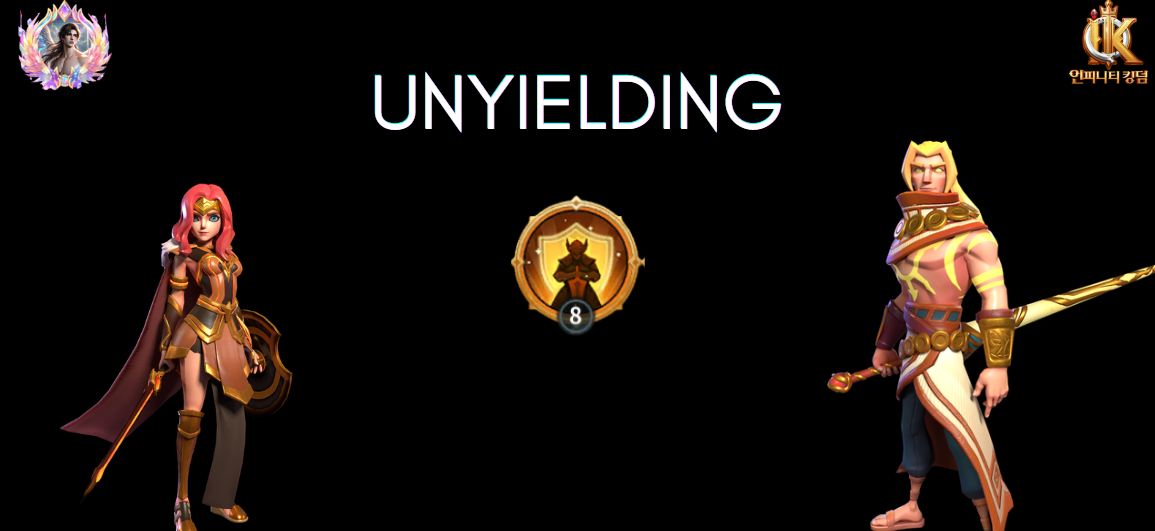
Some skills are active from the start.
Unyielding is not one of them.
It waits. It doesn’t change how the fight begins, it changes what happens once pressure builds. When your immortal drops low enough, the skill shifts the balance. Damage spikes, sustain kicks in, and suddenly the fight doesn’t look the same anymore.
This is not a passive bonus.
It’s a turning point.
Table of Contents
- What Unyielding actually does
- The 70% threshold and activation timing
- Crit and sustain working together
- Where the skill fits
- Limits and common mistakes
- How Unyielding plays out in real fights
Introduction
Unyielding is one of those skills that most players recognize, but few really build around.
It’s easy to understand on paper. A critical rate boost, some healing, and a condition tied to troop loss. Straightforward. But in practice, the way it activates, and more importantly when it activates, makes it very different from most other offensive skills.
It doesn’t help you dominate early exchanges. It doesn’t smooth out the first seconds of a fight. Instead, it comes into play once damage has already been dealt, once your immortal is under pressure, but still standing.
That moment matters more today than it did before.
Fights are faster, damage is higher, and thresholds are reached more abruptly. When Unyielding activates, it often defines whether your immortal stabilizes or collapses.
That’s why the skill feels inconsistent to some players and extremely powerful to others.
It’s not about what it does.
It’s about when it does it.
1. What Unyielding Actually Does
Unyielding is built around a simple condition. Once your immortal drops below 70% troop count, the skill activates and applies two effects at the same time: a massive increase in critical rate and a form of healing tied to physical damage dealt.
The critical boost is immediate and significant. A 50% increase is not a small adjustment, it’s a shift. If your build already leans into crit, this pushes it close to constant critical hits for the rest of the fight. Damage becomes more reliable, but also more explosive, especially in sustained exchanges.
At the same time, the healing component converts part of that damage into survivability. The more you hit, the more you recover. This creates a loop where offense directly fuels sustain, allowing the immortal to stay active longer than expected once the threshold is reached.
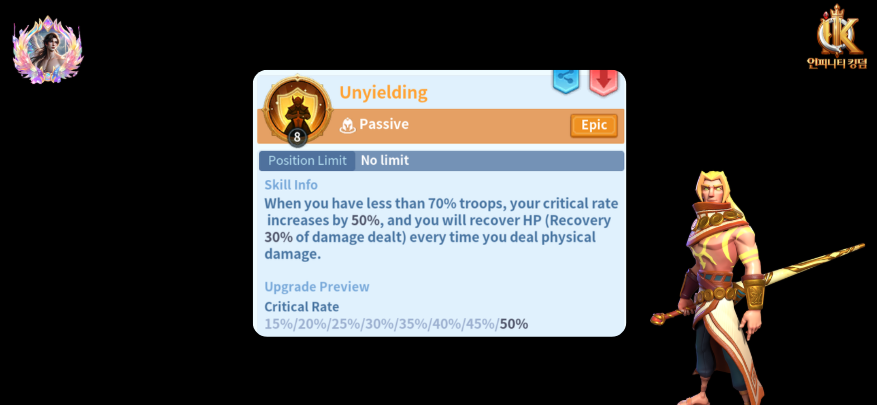
What matters here is that both effects trigger together. You don’t choose between damage or survivability. You gain both, but only after taking enough pressure.
That’s what defines the skill.
It doesn’t prevent damage.
It reacts to it.
Maël’s Opinion: The strength of Unyielding is not just the numbers, it’s the combination. A 50% crit boost alone would already be strong. Adding sustain on top turns it into something that can completely flip a fight, but only if the immortal survives long enough to use it.
2. The 70% Threshold — Where Everything Happens
Unyielding is entirely defined by its activation point.
Nothing happens above 70%.
Everything happens below it.
That threshold is not just a condition, it’s a timing window. It decides whether the skill becomes a turning point or remains completely irrelevant.
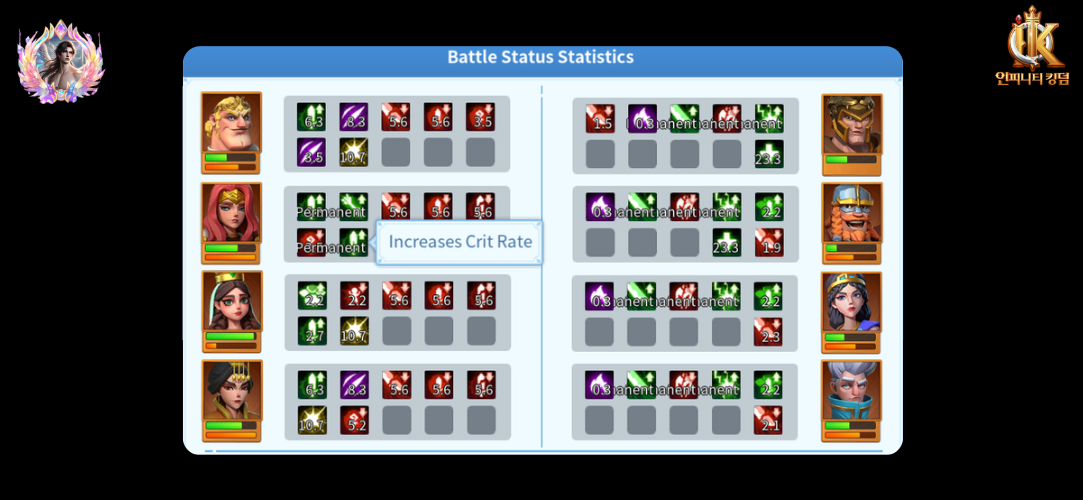
In slower fights, where damage builds gradually, the transition below 70% feels natural. The immortal takes pressure, drops into the threshold, and immediately gains both damage and sustain. From there, the fight stabilizes, and Unyielding starts doing its job.
In faster fights, it’s different.
If the drop is too sudden, if the immortal goes from 100% to near death in a single burst, the skill doesn’t have time to matter. It technically activates, but there’s no window left to benefit from it.
That’s why the same skill can feel either extremely strong or completely useless depending on the context.
It’s not inconsistent by design.
It’s sensitive to how damage is applied.
And that makes positioning, mitigation, and fight tempo more important than the skill itself.
You don’t just equip Unyielding.
You create the conditions where it can exist.
Maël’s Opinion: Most players misread this skill because they focus on the effect, not the timing. If your immortal can’t survive the drop below 70%, Unyielding has no value. If they can, it becomes one of the strongest turning points you can get.
3. Crit and Sustain — One Loop, Not Two Effects
Unyielding is often described as a crit skill with healing attached.
That’s not quite accurate.
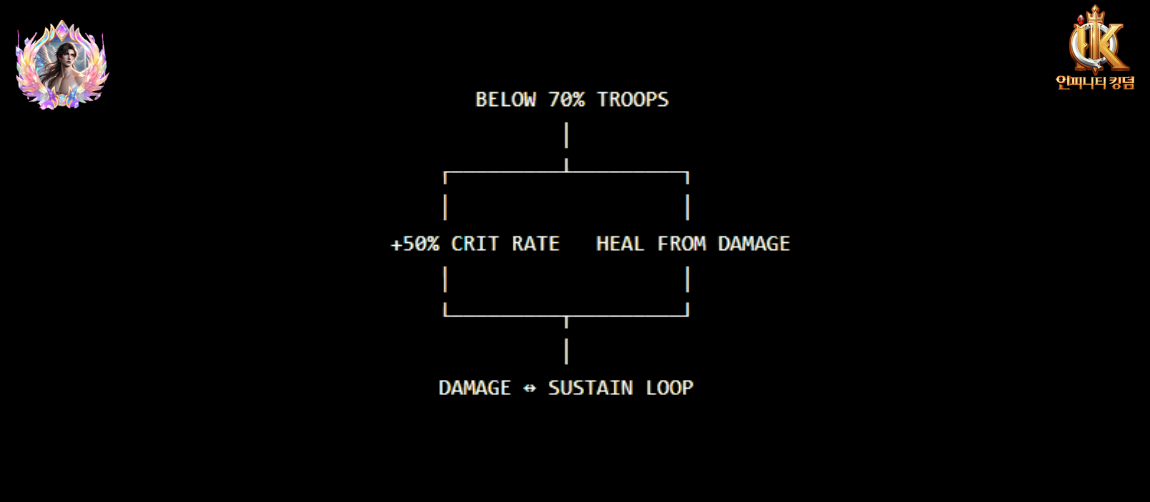
The two effects don’t just coexist, they feed each other. Once the skill activates, critical hits increase your damage output, and that increased damage directly amplifies the healing you receive. The more you hit, the more you recover, and the more you recover, the longer you stay in that high-damage state.
It becomes a loop.
You’re not just dealing more damage
You’re converting that damage into time.
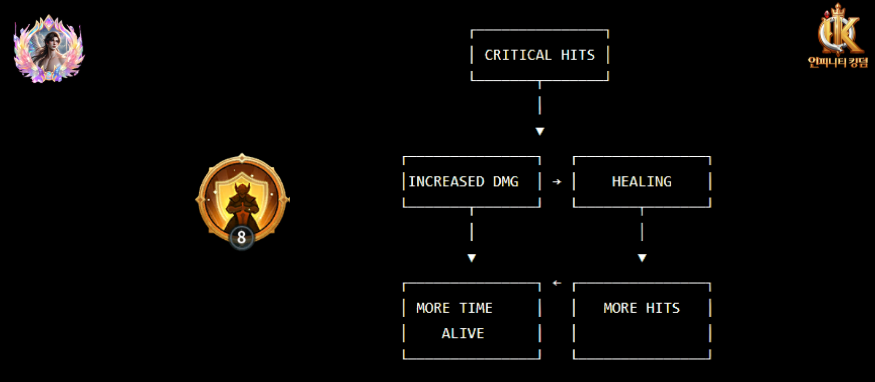
This is what makes Unyielding feel so different once it’s active. Instead of slowly losing ground, the immortal stabilizes and starts trading more efficiently. Incoming damage is still there, but it no longer pushes you out of the fight as quickly as expected.
That’s also why attack frequency matters. Immortals with fast attack cycles or repeated damage instances benefit more from this loop. More hits mean more healing triggers, and more healing means more time to apply pressure.
In the right conditions, this creates a phase where your immortal becomes harder to finish while still dealing meaningful damage.
Not invincible.
But difficult to close out.
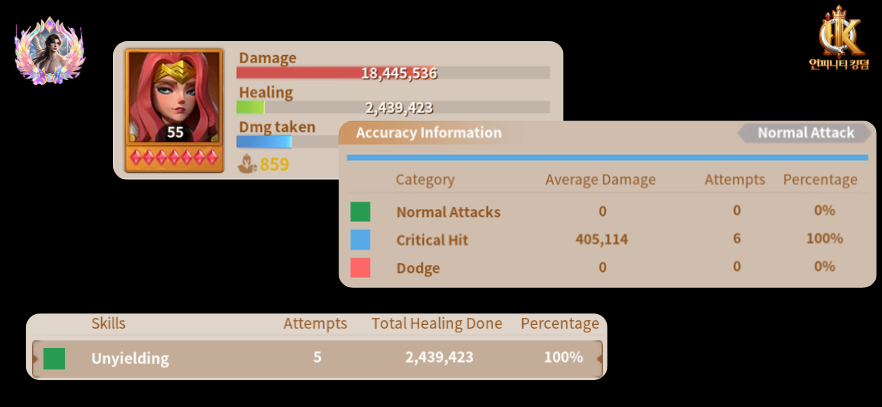
Maël’s Opinion: The real strength of Unyielding is this interaction. If it only gave crit, it would be strong. If it only gave sustain, it would be situational. Combining both turns it into a phase where your immortal can hold ground instead of collapsing.
4. Where the Skill Fits
Unyielding doesn’t define a build. It completes one.
It fits best in setups where your immortal is expected to stay in the fight long enough to reach that 70% threshold and continue trading afterward. That usually means frontline units or durable damage dealers, not fragile backline carries.
Frontline attackers naturally take pressure early. They drop below the threshold more reliably, and more importantly, they stay alive long enough to benefit from what comes after. Once Unyielding activates, they don’t just survive longer, they start trading damage more efficiently.
This is why it works so well on immortals that combine durability with sustained damage. Units that keep hitting consistently, rather than relying on one burst, are able to fully convert the crit and healing loop into real impact.
Backline glass cannons, on the other hand, struggle to use it properly. If they drop below 70%, it often means they’re already close to dying. There’s no real window to stabilize, so the skill ends up doing very little.
Unyielding also fits better in longer fights. In short, explosive matchups, there isn’t enough time for the skill to activate and matter. But in extended engagements, where pressure builds over time, it becomes much more reliable.
It’s not about putting it on your main damage dealer. It’s about putting it on someone who can survive the transition.
Maël’s Opinion: This is where most players get it wrong. They try to maximize damage instead of maximizing uptime. Unyielding is not about who hits the hardest, it’s about who can stay in the fight long enough to make the skill matter.
5. Limits and Common Mistakes
Unyielding feels powerful when it works, and that’s exactly why it’s often misused.
The most common mistake is assuming the effect alone is enough. Players see the 50% crit rate and the healing, and expect the skill to carry fights on its own. But without the right conditions, it simply doesn’t activate in a meaningful way.
The first limitation is timing. If your immortal is burst down too quickly, there is no real window to benefit from the skill. It triggers, but the fight is already decided. On the other hand, if your setup is too defensive and your immortal never drops below 70%, the skill never activates at all.
Both situations lead to the same result.
Zero value.
The second limitation comes from healing counters. Effects that block or reduce healing don’t remove the crit bonus, but they break the sustain loop. Without healing, Unyielding becomes a pure damage spike with no stabilization, which reduces its overall impact.
Then there is opportunity cost. Unyielding is not a free slot. Choosing it means not choosing another skill that may provide consistent value from the start of the fight. In faster metas or burst-heavy environments, that trade-off matters.
Finally, there is a misunderstanding of role. The skill is often placed on glass cannons because of the crit boost, but those are usually the worst users. If the immortal cannot survive the transition below 70%, the skill has no time to function.
Unyielding is not unreliable
It’s conditional.
Maël’s Opinion: Most of the frustration around Unyielding comes from misplacement, not from the skill itself. If it feels inconsistent, it usually means the fight doesn’t give it the time it needs. When it does, the difference is immediate.
6. How Unyielding Plays Out in Real Fights
Unyielding is not a skill you notice at the start of a battle.
It doesn’t show up in the first exchanges. It doesn’t influence the opening momentum. For a while, the fight plays out normally, and nothing seems different.
Then the threshold is reached.
Once your immortal drops below 70%, the shift is immediate. Damage becomes more consistent, hits start critting more frequently, and the healing begins to offset part of the incoming pressure. What looked like a losing trade can suddenly stabilize.
This is where Unyielding defines the fight. PVP or PVE
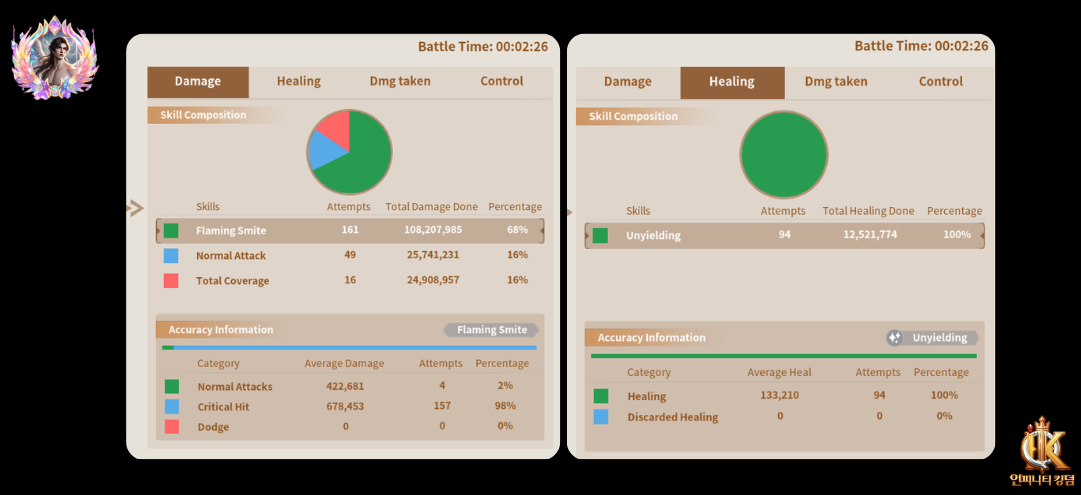
In some cases, it turns a collapsing frontline into a sustained presence. In others, it allows a damage dealer to stay active long enough to finish the job instead of being removed too early. The effect is not explosive, but it is decisive in extended exchanges.
You won’t always see it in the final damage numbers.
But you feel it in how long your immortal stays alive, and how much they do during that time.
And that’s the difference.
Maël’s Opinion: This is a timing skill more than a damage skill. When it activates in the right window, it changes the outcome of the fight. When it doesn’t, it feels invisible. That’s what makes it strong, but also easy to misread.
Conclusion
Unyielding is not a universal skill, but it is a powerful one in the right context
It doesn’t provide value from the start, and it doesn’t guarantee consistency across every fight. But when its condition is met and the immortal survives long enough to benefit from it, the combination of critical rate and sustain creates a phase where damage and survivability reinforce each other.
That’s where the skill shines.
Maël’s Final Opinion
Unyielding is not for every setup, but it rewards the ones that understand timing. If your immortal can reach that threshold and stay in the fight, the value is immediate. If not, the skill never gets the chance to matter. It’s not about raw power, it’s about creating the window where that power can exist.
For more insights, check out my previous articles here.
download Infinity Kingdom now and script your legend.
Until next time — Maël, Press Officer

Translate

Popular Posts
1
!["Festín de Caza y Trono de Sangre" La Guía Definitiva del Evento de Temporada [Evento] - Infinity Kingdom](https://oss.gtarcade.com/forum/gif/2026-05-24/546754_21e80f78-d91c-47da-bc8c-8d15fd886f91_011849.gif?x-oss-process=image/resize,w_150,h_150)
2
![“Ciro el Grande y las Llamas del Imperio” [Rincón de las Historias] - Infinity Kingdom](https://oss.gtarcade.com/forum/gif/2026-05-24/546754_91dcd4e9-8b06-492e-914f-d508b23bcfd7_000906.gif?x-oss-process=image/resize,w_150,h_150)
“Ciro el Grande y las Llamas del Imperio” [Rincón de las Historias] - Infinity Kingdom
192 discussions 198 views
3
!["El Último Latido de Asterion" [Capítulo 97] La Última Sanadora - Infinity Kingdom](https://oss.gtarcade.com/forum/gif/2026-05-24/546754_be674fbc-33f2-4ae3-b356-613e0a96a6b9_234130.gif?x-oss-process=image/resize,w_150,h_150)
"El Último Latido de Asterion" [Capítulo 97] La Última Sanadora - Infinity Kingdom
86 discussions 102 views