
This user has no description yet

fictions
💠Introduction
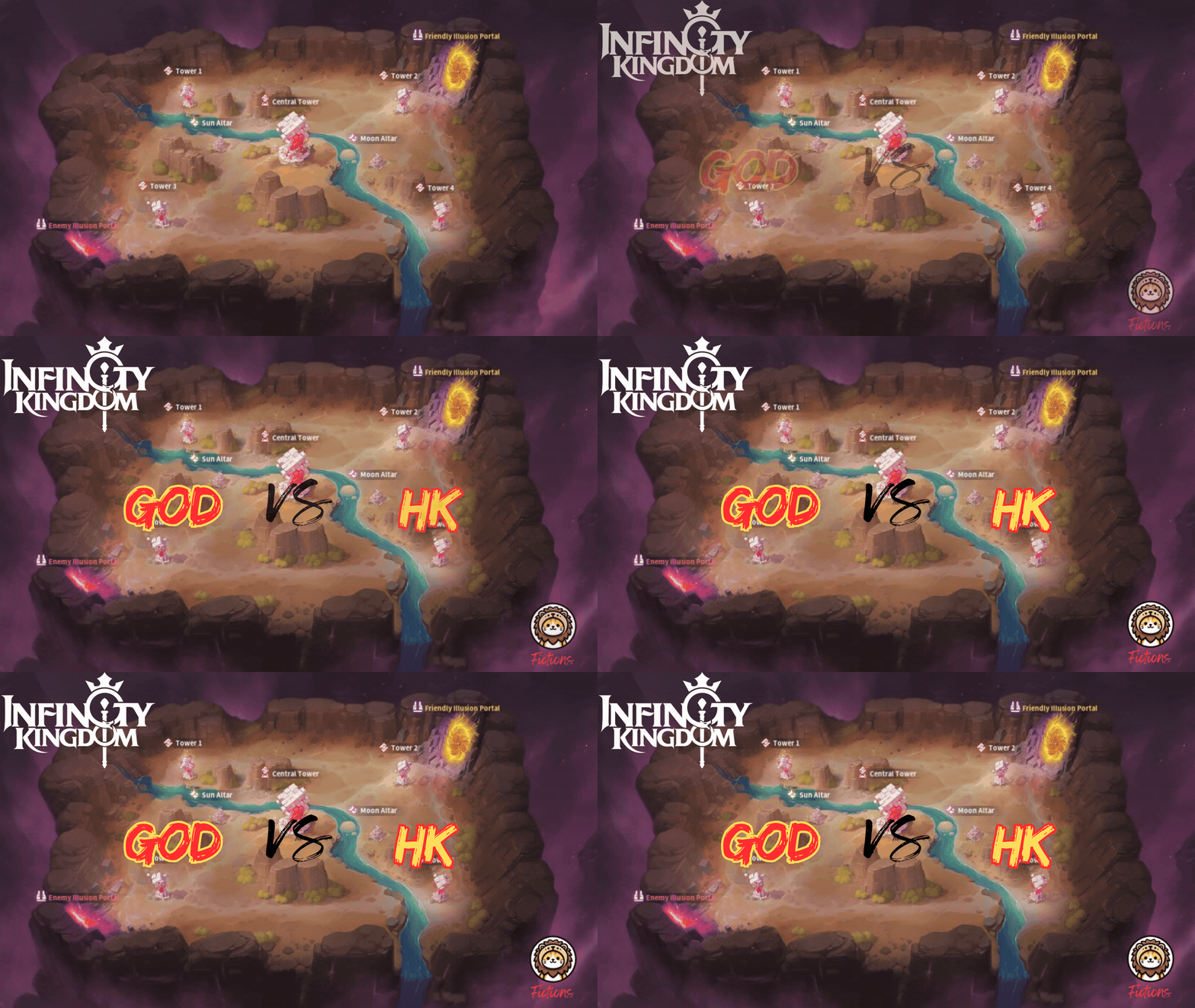
What’s up, folks? Welcome back to my Illusion Battlefield series, where I take a closer look at different matches and break down the strategies, positioning, and execution that decide them. Unlike Illusion Battlefield League, regular Illusion Battlefield allows players to use their own marches, skills, and builds, making account strength and individual setups much more important. Relocations are also slower, while incoming relocations take fewer hits to destroy, making positioning and relocation defense especially important because poorly placed attempts can be punished much more easily. In this article, I’m going to take a closer look at the matchup between Server 70’s Infinite Tsukuyomi (GOD) and Server 209’s Hungry Kitties (HK).
💠Table of Contents
- Overview
- Starting Positions and Talents
- Tower 1
- Tower 4
- Central Tower
- Altars
- Home Towers
- Play-by-Play
- Summary
💠Overview
GOD and HK are both mid-tier alliances with average firepower and below-average attendance, making this a relatively balanced matchup on paper. GOD recently strengthened its roster with several migrants from Server 277, while HK lost many of its strongest players to Server 38, narrowing the gap between the two alliances. Despite these roster changes, neither team has particularly impressive attendance, with both typically fielding only 15 to 20 players during the opening stages of a match. With limited manpower and comparable overall strength, both alliances should avoid spreading themselves too thin and instead concentrate enough players to create meaningful local advantages. Regular IB also places greater emphasis on individual march strength, so even a numerically inferior team can win an objective if its strongest players are positioned together and effectively protect incoming relocations. This matchup should therefore come down to player allocation, relocation execution, and which alliance can convert its strongest marches into sustained objective control.
💠Starting Positions and Talents
GOD
- Started with 18 players and ended with 22
- 7 Attack talents
- 10 Defense talents
- 1 Support talent
HK
- Started with 14 players and ended with 27
- 11 Attack talents
- 3 Defense talents
- 0 Support talents
GOD began with a four-player attendance advantage, but the situation changed dramatically as the match progressed, with HK eventually fielding five more players than GOD. Their talent distributions also reflected very different approaches. GOD leaned heavily toward Defense, with 10 of its 18 starting players using defensive talents, while HK favored Attack talents with 11 of its 14 starters. GOD’s setup should have been better suited for holding established positions and surviving prolonged fights, while HK’s aggressive distribution favored eliminating defenders quickly and applying pressure across multiple objectives. The key for GOD was therefore to capitalize on its early attendance advantage before HK’s late arrivals shifted the numbers in the opposite direction.
💠Tower 1
At Tower 1, HK committed three players while GOD sent only two, reflecting the attendance problems both alliances faced heading into the match. With neither team having enough players to effectively contest all three towers, both would have benefited from conceding one objective and concentrating their strongest players at the remaining two. HK had unfavorable spawn positions for Tower 1, making it more sensible to abandon the objective and focus on the Central Tower and Tower 4 instead. Conversely, GOD should have taken the opposite approach by concentrating its forces at Tower 1 and the Central Tower while conceding Tower 4. By spreading their already limited manpower across all three objectives, both alliances weakened their ability to establish control anywhere. A more focused two-tower strategy would have allowed each side to maximize its strongest marches and create fights where reinforcements, rallies, and garrisons could actually make a meaningful difference.
💠Tower 4
At Tower 4, GOD and HK each committed six players, with both alliances adopting nearly identical relocation formations around the objective. However, HK enjoyed a positional advantage due to its more favorable spawn locations, allowing its players to reach the area sooner and potentially punish GOD’s slower incoming relocations. In regular IB, this is especially important because relocations are easier to destroy than in IBL. If HK could eliminate even one or two GOD relocations before they completed, the nominal six-versus-six matchup could quickly turn into a substantial local numbers advantage. With both teams committing equal manpower, relocation defense and the strength of the individual marches around the tower would likely determine which side gained control.
💠Central Tower
At the Central Tower, HK committed five players while GOD sent eight, giving GOD a three-player advantage at the most important objective. Two GOD players attempted to relocate onto HK’s side of the tower to block incoming relocations and further increase that advantage. However, HK appeared to have more favorable initial spawn positions and potentially had an opportunity to reach the area first and punish those aggressive relocations. With attendance already limited, losing even one or two players before they completed their moves could dramatically change the balance of the fight. GOD therefore had the superior raw allocation, but converting that advantage depended on successfully protecting its relocations and preventing HK from using spawn proximity to reduce its numbers.
💠Altars
Neither team sent anyone to either altar. Given the low opening attendance on both sides, this was the correct decision. Every available player was far more valuable at the three major towers, and diverting manpower toward lower-value objectives would have weakened already undermanned fights elsewhere.
💠Home Towers
GOD stationed two players at its home tower while HK stationed three at theirs. Both teams were relatively conservative considering their limited opening attendance, particularly HK, which committed more than 20% of its starting roster to home defense. One defender likely would have been sufficient during the opening minutes, with additional players returning once an invasion became possible. Those extra defenders could have provided meaningful reinforcements at Tower 1 or the Central Tower instead of remaining idle at an objective that was not initially under threat.
💠Play-by-Play
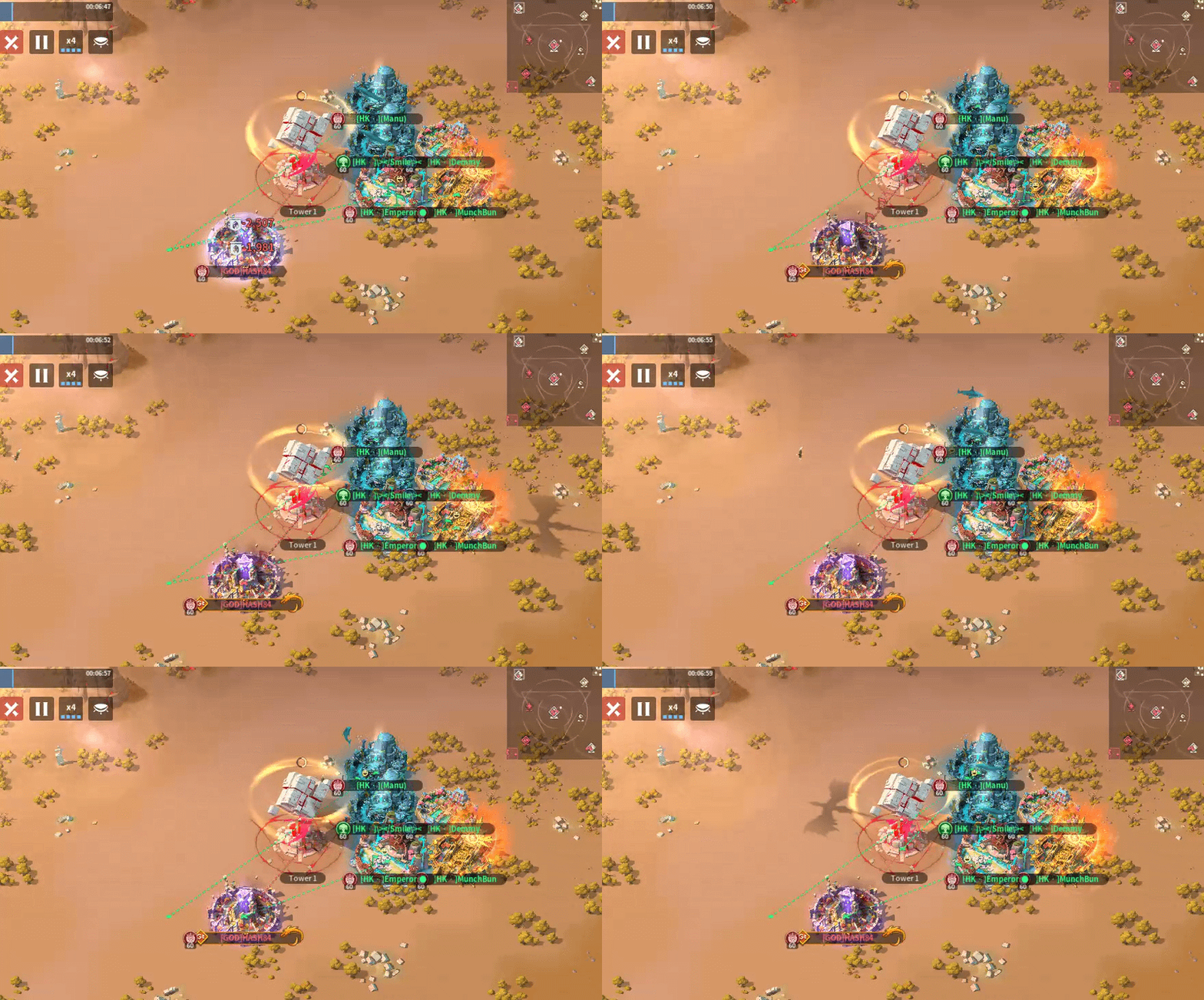
At Tower 1, HK reached the objective ahead of GOD and immediately capitalized on its positional advantage by destroying one of GOD’s incoming relocations. HK then began sieging the tower while simultaneously zeroing GOD’s remaining defender, effectively eliminating all resistance around the objective. When another GOD player attempted to relocate into the area, HK intercepted and destroyed that relocation as well, preventing GOD from rebuilding its presence. With the opposition completely cleared, HK captured Tower 1 just eight minutes into the match. Despite committing only a small number of players, HK demonstrated how favorable positioning and successful relocation denial can turn a relatively even opening into complete objective control.
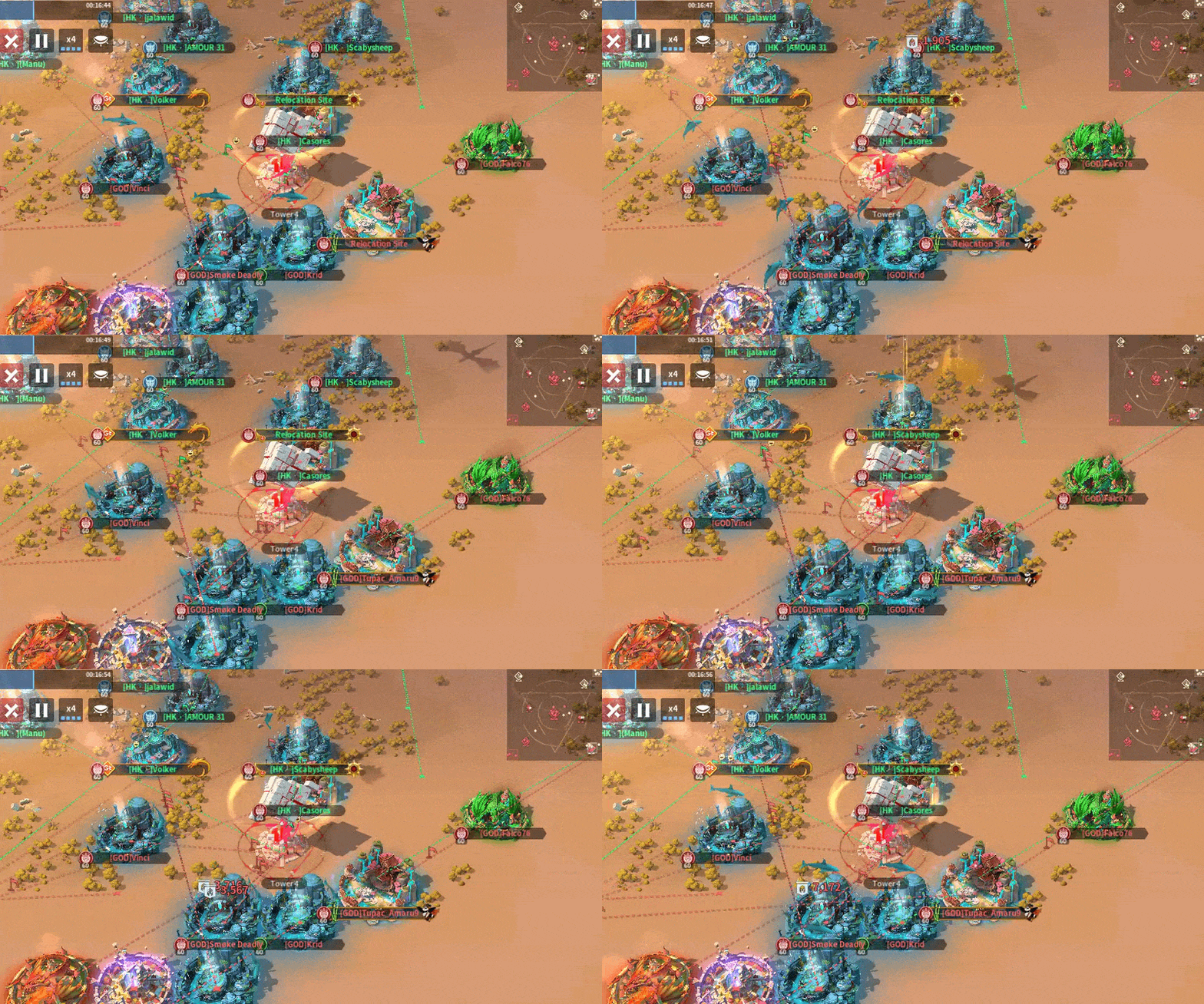
At Tower 4, GOD initially had an opportunity to establish control but struggled to eliminate the remaining HK presence quickly enough. A lone HK defender survived long enough for additional reinforcements to arrive, allowing HK to stabilize what could otherwise have become a vulnerable objective. This was a significant missed opportunity for GOD because its early attendance advantage gave it a limited window to create control before HK’s roster continued filling. Instead of converting that opportunity into a secure tower, GOD allowed HK enough time to reinforce and eventually turn the battle in its favor.
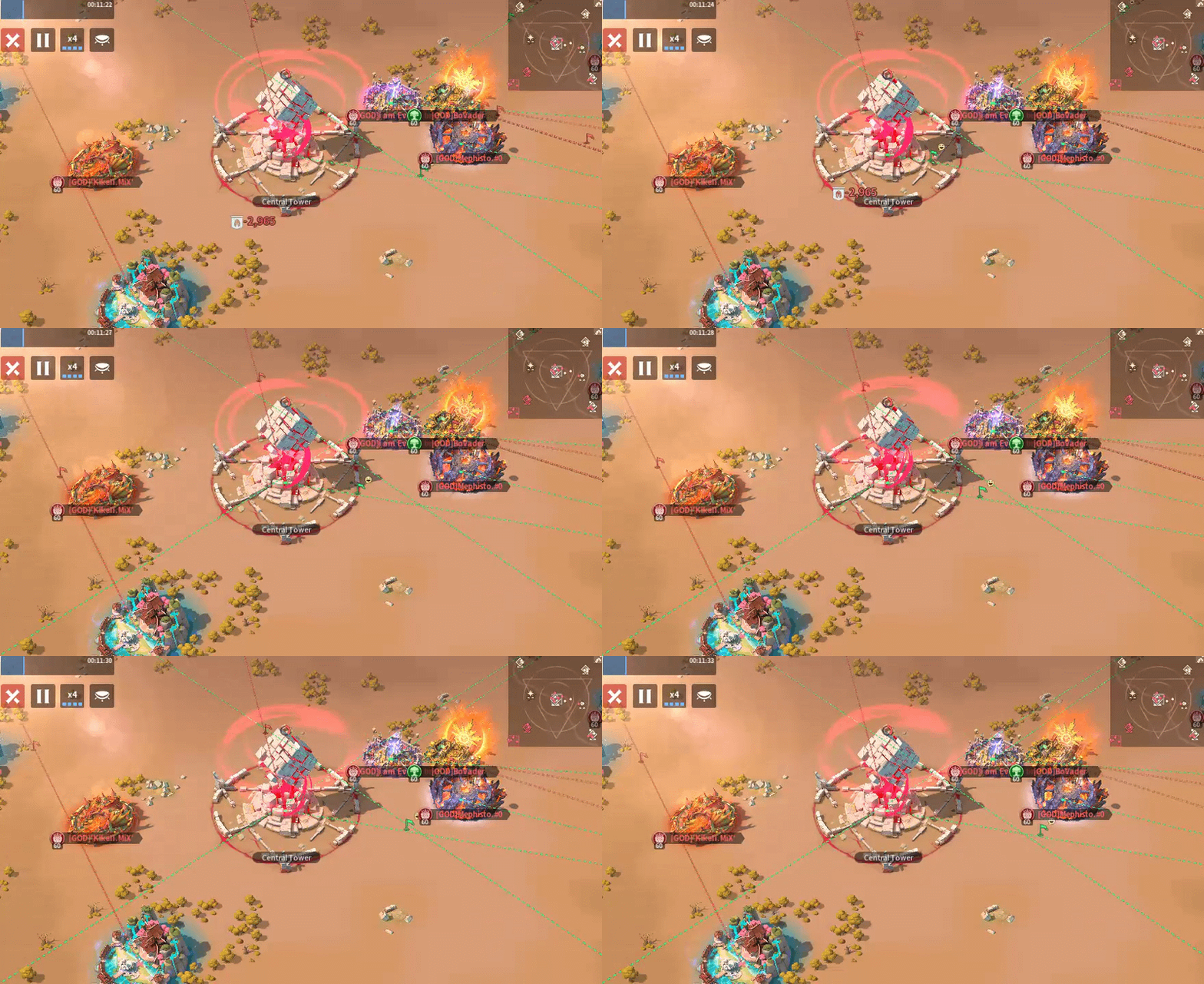
At the Central Tower, GOD delivered its strongest opening sequence of the match. GOD blocked one HK relocation and destroyed five others, completely dismantling HK’s deployment before most of its players could establish themselves around the objective. With HK effectively removed from the area, GOD gained uncontested positional control and began redirecting excess players toward other parts of the battlefield. The remaining GOD players continued sieging and captured the Central Tower at the 13-minute mark. This was an excellent example of relocation defense, as GOD turned its initial allocation advantage into complete control of the highest-value objective. The problem was that this success remained isolated rather than becoming the foundation for broader map control.
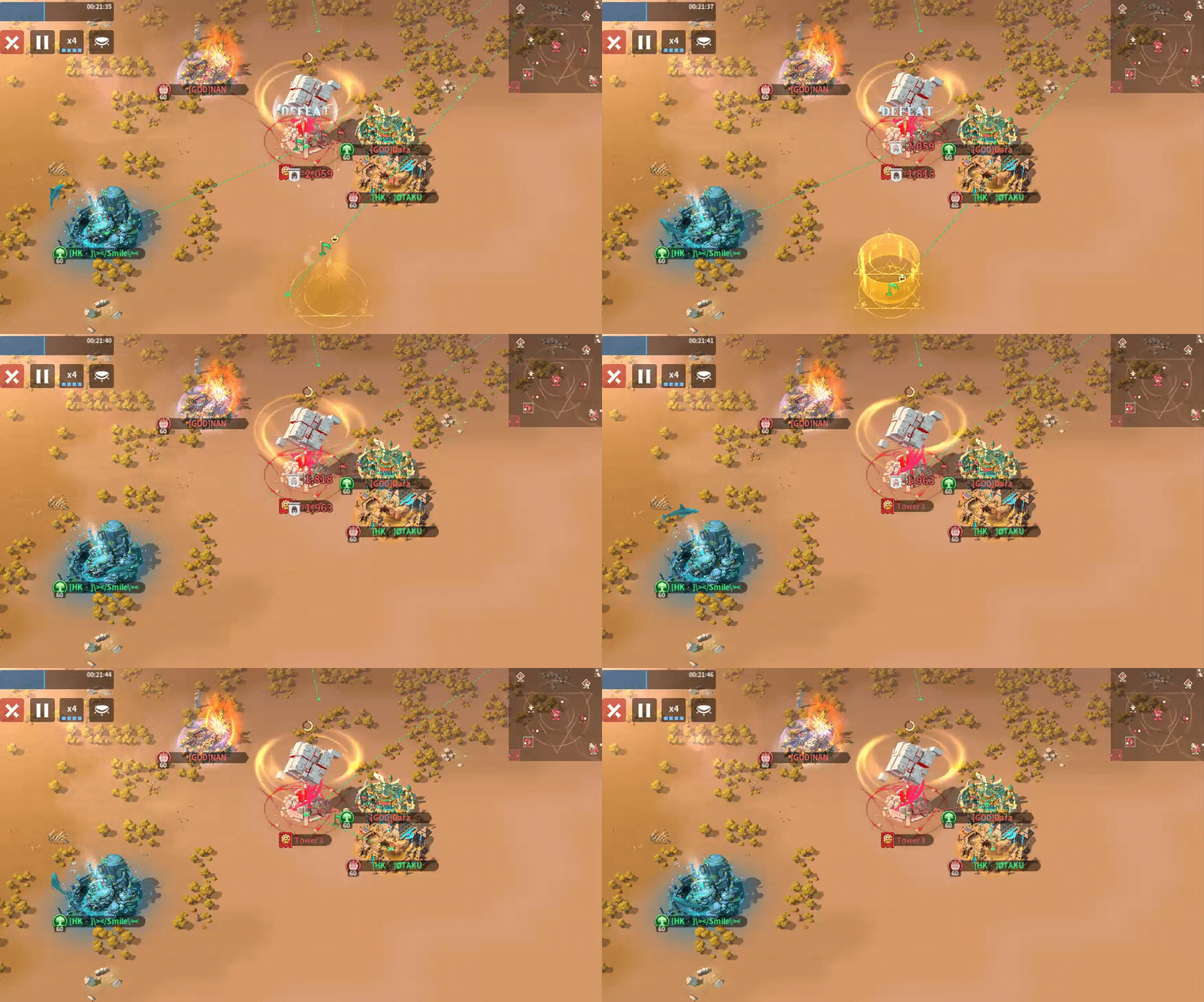
Sixteen minutes into the match, an HK player relocated to the outskirts of GOD’s home tower, where two defenders were stationed. He immediately sent troops toward the objective, but the guards successfully cleared his initial attacks. GOD began relocating additional players back to reinforce the tower, but two HK players teleported into the area and successfully blocked two incoming relocations. With GOD’s reinforcements unable to arrive, the remaining defenders were overwhelmed, allowing HK to capture its fourth tower at the 22-minute mark. More HK players continued relocating into the area to reinforce their position, while GOD struggled to organize an effective counterattack. Despite committing roughly half its team to the effort, GOD managed to zero only one HK player. GOD briefly reclaimed Tower 1, but HK quickly took it back, preventing GOD from establishing any sustained source of points outside the Central Tower. The home-tower invasion was particularly damaging because it forced GOD to react defensively while HK continued controlling the outer objectives, allowing HK to dictate the pace of the second half of the match.
💠Summary
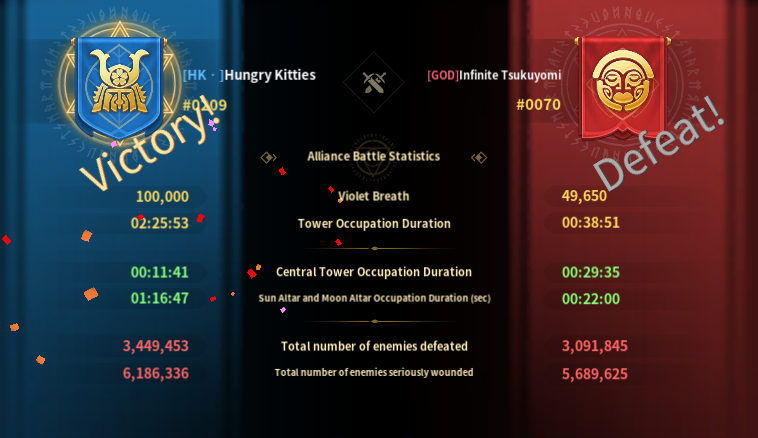
HK won decisively with 100,000 points to GOD’s 49,650, with Emperor earning MVP honors. The match was much closer strategically than the final score suggests, as both teams made questionable opening allocations and HK suffered a disastrous deployment at the Central Tower. GOD’s relocation defense there was arguably the strongest individual sequence of the match, blocking or destroying almost HK’s entire opening force and securing the highest-value objective with minimal resistance. However, GOD failed to convert that success into broader battlefield control. Tower 4 became a major missed opportunity when GOD could not eliminate HK’s remaining defender before reinforcements arrived, while HK’s stronger individual marches and more aggressive talent setup allowed them to gradually dominate the outer objectives. The turning point came when HK successfully invaded GOD’s home tower, blocked incoming reinforcements, and forced GOD to divert a large portion of its already limited roster into an unsuccessful counterattack. Although GOD maintained the Central Tower and briefly reclaimed Tower 1, HK controlled enough of the rest of the map to generate an overwhelming scoring advantage. Ultimately, HK was far from flawless, but its stronger individual combat performance, later attendance advantage, and ability to turn pressure into sustained objective control were enough to overcome GOD’s superior Central Tower execution.
What matchup do you want to see next? Let me know in the comments below!
💠Related Links
Version 3.0.0
Infinity Kingdom Official Website
PC
iOS
Android
#infinitykingdom #god #hk
Translate

Popular Posts
1

Hi there any one can help
192 discussions 216 views
2

[Beginner's Guide] Turn Gnome Battles into Reusable Immortal EXP | PT-BR & ES
83 discussions 126 views
3
Follow me for more code
138 discussions 194 views